Expert Fantasy Football Mock Draft 2026: 12-Team PPR Draft Results & Analysis


Entering draft season without real practice is the quickest way to derail your fantasy roster before Week 1 even begins. While managers flood lobby after lobby, many fall into a common trap: relying on corrupted, automated data.
In today's landscape, a typical fantasy football mock draft often devolves into an echo chamber of host-site default rankings. Casual drafters tend to stick around for the first three or four rounds before jumping ship, leaving auto-pick algorithms to select the rest of the board. Alternatively, managers flock to paid best-ball leagues seeking "skin in the game." While best-ball keeps participants engaged through all rounds, its format requires a drastically different strategy than a standard home league. Best-ball heavily rewards roster construction strategies like structural stacking, deep wide receiver rooms, and chasing weekly volatility, tactics that can leave a home-league roster completely depleted at crucial starting positions.
To gain a legitimate competitive edge, you need to participate in or analyze an authentic expert fantasy football mock draft. Unlike automated rooms or best-ball drafts, expert lobbies feature high-stakes managers who actively draft through every single round, offering a realistic blueprint of actual human behavior.
Studying draft boards from true expert mocks provides context that static Average Draft Position (ADP) lists simply cannot capture. Raw ADP tells you where a player is taken on average, but analyzing completed draft boards reveals why and when positional runs happen.
For example, executing a 12-team PPR mock draft with attentive drafters exposes critical inflection points:
- Positional Crises: You quickly see the exact round where the elite target-earning wide receivers dry up, or when a sudden run on mid-tier running backs forces drafters into reaching.
- True Market Trajectory: You identify which players are actually rising or falling based on real summer training camp news, rather than waiting weeks for platform default rankings to adjust.
- Value Windows: You learn where elite quarterbacks or tight ends naturally fall relative to target-heavy flex options.
Static rankings give you numbers; reviewing high-quality mock draft boards gives you situational awareness. By testing your strategies against dedicated drafters who stay engaged for all 16+ rounds, you enter your draft prepared for every curveball, positional run, and value slide that comes your way. This is why we put together a group of fantasy analysts who deserve a little extra time in the spotlight to put their own player takes and draft strategies on display with the sole goal of making you a better fantasy football drafter.
Draft Participants (in Draft Order)
- Dustin Ludke, FFToday & Dynatyze - @theDunit13
- Seth Miller, Fantasy Pros - @crossroadsffp
- Colin McTamany, FTN Fantasy - @Colin_McT
- Michael Reedy, Fantrax - @MikeReedyFF, @mikereedy.bsky.social
- Kevin Tompkins, Fantasy Alarm & The Huddle - @ktompkinsii.bsky.social
- Drew DeLuca, Fantasy Pros & QBList.com - @drewdelaware.bsky.social
- Josh Montanye, Dynatyze - @ELITE_Fantasy_
- Scott Bondar, Fantasy Guru - @ScottBondar
- Kevin Grealey, Fantasy Draft Channel - @fantasydraftCH
- Jeremy Ekern, Substack - @TheEkernEdge
- Howard Bender, Fantasy Alarm - @rotobuzzguy
- Jason Baumbach, The BMO Channel - @CarlFromJersey
2026 Fantasy Football 12-Team PPR Mock Draft Board
As always, I would like to thank your friends over on RTSports.com for allowing me to host these mock drafts on their platform. If you are having trouble reading the draft board below, feel free to CLICK HERE, and a copy of the board will open in a new window and allow you to change the size of the text.
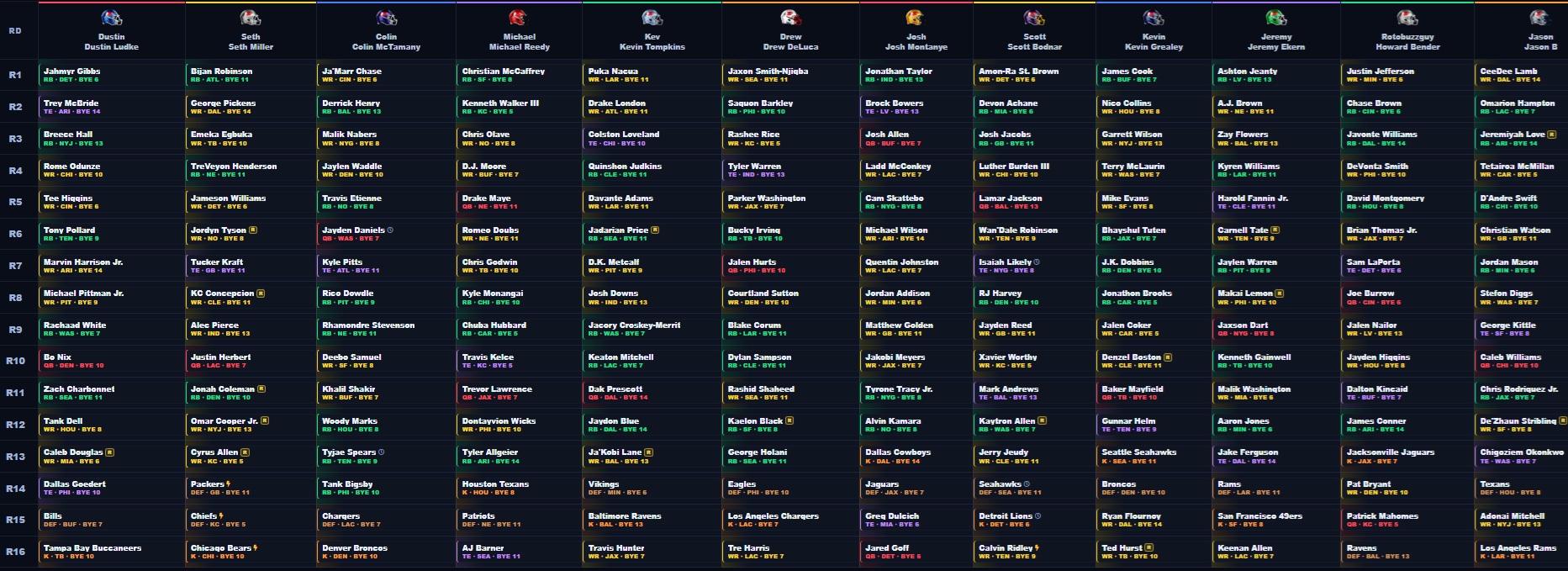
Key Takeaways from Our Expert Mock Draft
Having done hundreds of mock drafts using the Fantasy Alarm Mock Draft Simulator, including the Perfect Draft Series here in the Draft Guide, nothing really surprises me when the fantasy experts step into a 12-team PPR mock draft. I expect them to follow the trend and go RB-heavy in the first two rounds, wait on the quarterback position (with a few exceptions), and overdraft the middle-tier of tight ends. Kickers and defenses should wait until the end. Is that what we saw? Is that what you will see in your home league draft?
- Drafting QBs: This one is always dangerous when watching a bunch of fantasy analysts in the room. As you can see, the majority of the room waited, and while that continues to be the lean for most advice given, you’re unlikely to see your home-league follow suit. In this case, Josh Allen went in the third, and then we waited a good two rounds before Drake Maye and Lamar Jackson were taken. Typically, the floodgates open a little wider, so you can expect Rounds 3-5 to house the top two tiers of the position while the middle rounds (Rounds 8 & 9) are where you can probably see players like Caleb Williams and Justin Herbert go. Just remember, when you see quarterbacks going earlier than you did here, understand that another position is going to get pushed down. Maybe it’s the depth running backs, maybe it’s the slot receivers, or maybe it’s the middle tier of tight ends. That’s the most important trend you have to pay attention to – if people are taking a position earlier than expected, there will be additional value at other spots available to you in the later rounds.
- Drafting RBs: As expected, running backs came off the board at a more rapid rate than what we’ve seen in seasons past. Nothing outlandish, but they made up 50-percent of the top 24 picks. Given the names on the board, things never came to a grinding halt, as at least two running backs were taken in Rounds 3-7, with a strong increase in Rounds 7 and 8 when both the RB-heavy drafters and those who went heavy-WR in the early rounds returned to the position for both starters and depth.
- Drafting WRs: Similar to the draft trends we’ve witnessed over the past few seasons, the wide receiver position continued to get its usual attention. Sure, maybe there are fewer receivers taken in the top two rounds, but during the RB dead-time (Rounds 3-7), receivers dominated the draft board. This is common for leagues that require you to start three receivers and have at least one flex spot. It’s the deepest position out there, so it’s easier to find depth in the later rounds.
- Drafting TEs: It always starts the same way – Brock Bowers and Trey McBride come off the board in the second round; maybe early third, but that’s the latest. Colston Loveland finds his way into the late third. Then you usually see the room wait a round or two before going after guys like Tyler Warren, Harold Fannin, and Tucker Kraft, but that was not the case in this mock. We saw the next group of tight ends come off the board a little earlier, so watch for that potential trend in your draft, especially if you’ve got competitors who play in the FFPC or other TE-premium formats. Sometimes it’s tough to turn off the brain when you’ve been elevating a particular position for a number of drafts
Round-By-Round Draft Strategy Lessons
While further down this 12-team PPR mock draft write-up, you’ll be able to hear from all the draft participants. For round-by-round strategies, I’ll take a quick spin through my draft out of the 11th spot.
- Round 1: Best player available. I’m usually an RB-heavy drafter, but couldn’t let Justin Jefferson pass me by, especially now that we got confirmation that Kyler Murray has been named the starting QB for the Vikings.
- Round 2: I wasn’t going to let the draft move past me without grabbing a strong RB1 to anchor my roster.
- Round 3: What can I say? I’m a Robust-RB kind of guy, and Javonte Williams is one of the last remaining bell-cows.
- Round 4: With two strong RBs on the roster, it’s about best player available once again, regardless of the position they play. DeVonta Smith stood out the most to me.
- Round 5: Same rationale as the round before, but it also helps grab that RB3/flex so you don’t have to worry about getting shut out of the position further into the draft.
- Round 6: We start three receivers, and with so many people grabbing running backs early, I knew this was the time to grab another receiver who will be starting for me each week.
- Round 7: I have seven tight end targets in most drafts, and since I know I’m never reaching for Brock Bowers or Trey McBride, I know the list is really five. Sam LaPorta was the last available from my list, so I grabbed Drew Petzing’s new favorite toy.
- Round 8: Looking at all the other positions and feeling somewhat underwhelmed, adding Joe Burrow seemed like a no-brainer. Might as well take a top-five QB to use every week as opposed to a flex play who may or may not make my starting lineup.
- Rounds 9-16: Aside from a kicker and a defense, it was all about adding depth and finding some upside. I do wish I had one more depth RB on my roster, but the draft just didn’t fall that way. If this were a league to be played out, I’d be very happy with the results, but also know that I need to be aggressive on the waiver wire when it comes to running backs.
Most Surprising Picks
Michael Wilson, WR Arizona Cardinals (Round 6, Pick 66)
Seeing him go ahead of Marvin Harrison is very interesting. Yes, new head coach Mike LaFleur told the media that Wilson would be in the “Puka Nacua role” and Harrison the “Davante Adam role,” but that doesn’t tell me who is seeing what targets. All it tells me is that they like Harrison in that big split-end role and Wilson as the slot/flanker. Target distribution is going to be a very interesting watch here in training camp.
Jordan Mason, RB Minnesota Vikings (Round 7, Pick 84)
Probably the one pick that stands out as a reach above ADP, but likely with good reason. Jason grabbed Mason as his fourth running back, but with questions surrounding Jeremiyah Love’s role and D’Andre Swift sharing the workload with Kyle Monangai, adding Mason, who serves as the early-down back for the Vikings, is a solid move to add some depth to an already tough position.
Jonathan Brooks, RB Carolina Panthers (Round 8, Pick 88)
I will never understand people going all-in on Brooks or even taking him ahead of Chuba Hubbard. He hasn’t played an NFL down in two years, and while yes, someone mentioned he looked good in camp back in late July, there has been no indication that he has surpassed Hubbard on the depth chart, nor has anyone come out and said this is going to be a shared backfield.
Best Draft Values
Kyren Williams, RB Los Angeles Rams (Round 4, Pick 39)
The workload and snaps were split roughly 70/30 in favor of Williams, and yet, everyone wants to elevate Blake Corum as a guy who is taking over the job. He isn’t. Plain and simple. He is a complementary back who may see a 30-40-percent snap share, but what kind of quality are those carries? Garbage time to chew up the clock? The occasional series where Williams needs a breather? If the public is going to continue letting Williams slip into the fourth round, I’m going to scoop him up every chance I get.
Justin Herbert, QB Los Angeles Chargers (Round 10, Pick 110)
This is just a note to remind you that industry mocks are filled with people who are happy to wait on the QB position. I highly doubt you see guys like Herbert or Trevor Lawrence fall this far in your home league. Check out where I have them and other QBs in their range in the Fantasy Football Cheat Sheet Draft Grid, which is likely a better representation.
Dallas Goedert, TE Philadelphia Eagles (Round 14, Pick 168)
He’s the forgotten man, and no, it’s not really about Eli Stowers either. Goedert should be a perfectly fine, startable tight end for your fantasy teams. You’re not getting overwhelmingly strong production, but the loss of A.J. Brown, the injury status of Makai Lemon, and the lack of reliable receiving depth tell me that Goedert should remain a favorite target of Jalen Hurts.
Best Team Builds
Michael Reedy (Pick 4)
Love the two-back build right from the start and then the move to the wide receiver position. He didn’t go overkill and pile on more RBs, and he grabbed value receivers where he was able. The Drake May add was perfect, especially because he went back and added more depth at receiver. He even went back to the running back position for two solid picks in Kyle Monangai and Chuba Hubbard after securing a top-3 quarterback. Big fan of the build here.
Scott Bondar (Pick 8)
What I like about Scott’s draft is that he also grabbed the security of two strong running backs, but managed to grab Amon-Ra St. Brown first. I did the exact same thing at Pick 11, and by the time we were both done with eight rounds, we had our starters locked in. We have high-end QBs, top tight ends, and we used the other six picks for running backs and wide receivers. No muss, no fuss. He may be a little light on RB depth, but he’s more than solid everywhere else, and if we were playing this league out, he would just need to be more aggressive on the waiver wire for early RB injuries.
How Our Expert Mock Draft Compared to Real ADP
While ADP is supposed to be considered a guideline rather than the gospel, it is easy to see with this particular mock draft that most, if not all, of the drafters adhered to the consensus ADP. I couldn’t find any blatant “get your guys” moments, nor did I see any outlandish reaches past the ADP. The Jordan Mason pick mentioned above, and maybe Drew DeLuca (6th Pick) grabbing Jalen Hurts ahead of Joe Burrow, but even that pick, if you believe Hurts could continue to run more and poach short-yardage touchdowns, isn’t totally off the wall.
That people stayed close to ADP is not necessarily a bad thing. It’s a sensible draft. It’s worth noting that in your home leagues, the players from your local teams traditionally go a little higher in drafts, and more fantasy players who are not connected with the industry are likely to take bigger swings on some of their favorite players. But we see drafts like this on the regular. The advice is to use ADP as a sensible guideline, but never be afraid to take a player you want a little earlier than the general consensus says. After all, this is your team, and you’re the one who needs to be happy with it.
But enough about what I have to say. Let’s take a look at what our invited drafters had to say about their drafts.
Mock Draft Expert’s Analysis
Dustin Ludke, FFToday & Dynatyze - @theDunit13
I came into the draft planning on waiting on both Quarterback and Tight End. Getting the 1st overall pick made that fairly impossible and continued to force most rounds.
I felt fairly hemmed in at the 2-3 turn. Seeing Trey McBride there, with that to me, is a wide receiver and running back dead zone, was a no-brainer despite my pre-draft leanings. It was a reach to get Hall at 3.01, but I’m bullish on his upside.
Seeing 13 receivers get drafted before my 4-5 turn picks and the long stretches between picks forced my hand to draft 4 receivers in the next 5 rounds. With it being a start-3-wide-receivers league, half of the first 4 rounds of picks were wide receivers. It took away a ton of the depth of that position. I still feel like there were values to be found, but you had to scroll down the ADP list to find them.
I played chicken at QB and couldn't be happier to get Bo Nix (Den) in the10th round as QB10. He has a high rushing upside and some new weapons this year. I wish I was able to scoop up a stack with him, but the draft didn't fall my way.
Overall, I feel like I ended up drafting a team with a solid floor. I'm a more cautious drafter than most, so I don’t have a ton of big-game upside, but I don’t like a ton of risk on my teams. I have some with receivers Tank Dell and Caleb Douglas. Both of those are late-round guys you had to scroll to find.
Seth Miller, Fantasy Pros - @crossroadsffp
I’m always open to going with the draft flow, but 2026 feels like going RB-RB with your first 2 picks is the best way to set yourself up for a great snake draft. I, of course, didn’t go RB-RB, but ended up loving my starters, like we all tend to do after drafting their preseason team.
My bench is a different story, comprised almost entirely of what is considered a disappointing rookie class. On the plus side, they will be easy to ditch when week 1 waivers hit.
Something I forget when only mock drafting against bots up until my important real ones: don't rely on the ADP cushion that gives you false comfort in thinking you’ll get your guy because he's further down the screen - he will be sniped every time! Finding a balance between taking the value on the board versus who you really want (often earlier than you planned) is a difficult one to find.
Final thought about this particular draft: QB strategy was almost too sharp. In a real situation, it would be tempting to immediately go out and grab one of Purdy, Goff, Shough, Love, Murray... it goes on. Passing on Herbert and drafting an RB flyer attached to a good offense instead (like Chris Rodriguez) might have been more advantageous.
Colin McTamany, FTN Fantasy - @Colin_McT
My strategy was to draft for upside and swing for the fences regardless of risk. I think I accomplished that goal in drafting 32-year-old Derrick Henry and Malik Nabers, coming off of a season-ending ACL injury, with two of my first three picks. It's rare to find me filling out my starting lineup before addressing my bench, especially in 2026 drafts thus far. Typically, I'm one of the last managers to select a quarterback. Jayden Daniels in the sixth round is great value, but I was harshly reminded later why I tend to wait, as Dak Prescott came off the board with the 11.06 pick. There are still some high-quality free agent quarterbacks available post-draft, as well. Overall, I feel that the players in my starting lineup all have the ability to finish at or near the top of their positions. I would hope this roster is still intact when December rolls around, but this collection of players should be able to stack up wins early and often.
Michael Reedy, Fantrax - @MikeReedyFF, @mikereedy.bsky.social
This mock draft was a perfect example of Adaptive Draft Strategy, rather than walking into a draft committed to Zero RB, Hero RB, or any other rigid approach. Early in this draft, managers aggressively attacked wide receivers, which created unexpected value at running back and quarterback. Rather than force a WR because “that’s what the Zero-RB guys say to do,” I pivoted and built around Christian McCaffrey and Kenneth Walker, giving my roster two backs with league-winning upside.
From there, I shifted focus to try and get value and upside at every turn. Chris Olave and DJ Moore gave me two receivers capable of commanding heavy target shares, while Romeo Doubs was a homer value pick at WR, as I think his volume will outproduce his ADP. I drafted Drake Maye in the fifth and later followed with Trevor Lawrence as insurance, giving me two options that have top-10 value at QB. For my bench, I targeted players who should increase in value during the season; Kyle Monangai, Chuba Hubbard, Tyler Allgeier, Chris Godwin, Dontayvion Wicks, and AJ Barner all have paths to becoming weekly starters if opportunity breaks their way. Some of this is simply paying attention to the camp news and how these guys look like they will be utilized once the season begins. I was looking to mitigate risk with my earlier round picks and find players as the draft moves on that have a serious shot at outproducing their ADP.
Kevin Tompkins, Fantasy Alarm & The Huddle - @ktompkinsii.bsky.social
Drafting from the 1.05, I truly enjoy this team from top to bottom. I started off with two wide receivers in Puka Nacua and Drake London, who can both earn at least 150 targets each and be incredibly efficient with them. Nacua, of course, had an incredible season in 2025, capped with a 3.82 yards-per-route run in 2025, the third-highest YPRR all time (min. 200 routes) since 2006.
The Chicago Bears’ pass-catchers have gotten a lot of buzz this offseason, but the most insulated of the trio is tight end Colston Loveland, who will build off his end of last season to become Caleb Williams’ favorite target this season in Year 2 of the Ben Johnson offense. It's a steep price to pay, having gone a half-round after Trey McBride, but the price is right for Loveland.
In atypical fashion for a Kevin Tompkins team, two running backs are drafted in Rounds 4-6: Quinshon Judkins and Jadarian Price. Judkins is a question mark in terms of team touchdowns, but he’s young and the unquestioned workhorse for Cleveland. Price, drafted at the end of the first round in the real-life NFL Draft, will have a role from Week 1 and then grow into it, even when Zach Charbonnet returns from his knee injury.
Outside of those top picks, we have veteran values like Davante Adams, DK Metcalf, Josh Downs, and Dak Prescott to stabilize the floor of this team, with plenty of upside with Jacory Croskey-Merritt, Keaton Mitchell, Jaydon Blue, and Ja’Kobi Lane for upside. It’s a fun and balanced team!
Drew DeLuca, Fantasy Pros & QBList.com - @drewdelaware.bsky.social
This draft was loaded with sharp, savvy drafters! My strategy going in: grab at least one rock-solid running back and a stud wide receiver in the first three rounds, then remain flexible and let the board guide my next move. After choosing Jaxon Smith-Njigba and Saquon Barkley in the first two rounds, I opted for Rashee Rice at 3.06, who, despite a minor injury concern, has more yards after the catch (8.0) than any other WR over the past three seasons. I'm thrilled with him as a WR2 and can comfortably roll with Parker Washington and Courtland Sutton as WR3 and WR4 in a 12-team league.
A quarterback in Round 7 was unplanned, but Jalen Hurts and Justin Herbert were too enticing to pass up. I have plenty of exposure to Herbert so far this season, so I opted for Hurts, who is being drafted at his floor right now after the disaster that was Kevin Patullo's offense in 2025. Typically, I pound wide receiver value here, but a glut of similar ones were available at this point; I ended up taking one (Sutton) a round later.
I confess, I had a side quest going into this draft: in Round 4 or 5, grab one of the top four tight ends, if possible. Tyler Warren completed the mission at 4.07. The TE4 in this draft, the Penn State standout, had 112 passes thrown his way as a rookie in 2025 and should absorb many of Michael Pittman's 111 vacated targets this coming season. He is prominently featured as my overall TE1 this coming season as one of my Bold Predictions on QBList.com. Had Warren and Loveland been off the board by 4.07, I would have waited until the later rounds. Howard took Dalton Kincaid in that area, one of my favorite targets when I choose to be more patient at the position.
In that late stage of the draft, I threw as many darts at upside running backs as possible to find a potential league-winner in the FLEX position behind Barkley and Bucky Irving. Blake Corum in Round 9 is the clear best bet. Kaelon Black and George Holani are two lottery tickets who can be jettisoned in favor of better waiver wire options if they don't pan out. Black is well-positioned to play a major role in Kyle Shanahan's offense if Christian McCaffrey is unable to carry the load in a 430+ touch season. Holani will have a role out of the gate for the Super Bowl Champion Seahawks, perhaps bigger than we think: rookie Jadarian Price is learning the offense while Zach Charbonnet heals from a serious ankle injury.
Josh Montanye, Dynatyze - @ELITE_Fantasy_
I like the team I built tonight. I have the best QB and TE combo available with Josh Allen and Brock Bowers. Jonathan Taylor adds to this Big 3 at RB, but leaves me wanting more at WR.
I like Ladd McConkey and Quinten Johnston's potential with McDaniel as their new OC, and Michael Wilson showed us last year he can score 35+ points in a game when given the targets. Jordan Addison and Matthew Golden are some of my sleeper picks this season, and I like them at this ADP. I can see all those guys breaking out. Addison with the addition of Kyler, and Golden with the WR room cleared out; the Packers are saying they’ll be using him as their X and letting Watson play Z. My WR room has a lot of room to grow, and I think these guys will be serviceable and could surprise the other teams in this league by turning into a middle-of-the-pack group of guys. I’ll be playing matchups and looking into how they fit stylistically against their opponents on a weekly basis.
I like Cam Skattebo as my 2nd RB, and I was happy I could get Tyrone Tracey later in the draft with the injury risk for Skattebo. Having Alvin Kamara as my backup RB is a bit of a concern, but I think to start the season we’ll see him split opportunities with Etienne. I’ll have to keep an eye on the waiver wire and make a move for another RB late in the season once the veteran’s touches start to decrease.
Being the first to take a Kicker/DST is always interesting because you get the best guy, but sacrifice a little bit of depth. Looking at who else went, I didn’t miss out on anyone I was hoping to snag. Jacksonville’s DST has one of the easier schedules relative to the other top DST’s in the league, like Denver, who’s got the Chargers and Chiefs, and the Rams, who have the 49ers and Seahawks.
If I were to do this over again, I’d probably wait on QB, and take a WR like DeVonta Smith, or reach for a guy like Christian Watson instead of Cam Skattebo to shore up my WR position.
Scott Bondar, Fantasy Guru - @ScottBondar
The goal was to construct a roster blending elite potential with reliable production and breakout candidates
Picking 8th, I was thinking excited to see Amon-Ra St. Brown at 8. I would have picked him as high as 3rd. He is a consistent scoring rock as a WR1.
2nd-round pick: I saw Achane on the board, and even without McDaniel, he will be the focal point of that offense
3rd pick: Josh Jacobs was there to provide the workload stability to pair with Achane as a red zone presence and stable backfield. Doubtful his suspension happens.
4th rounder needed a WR2 with upside, and despite the groin injury, Luther Burden is the “tout favorite” breakout star, and if his upside is similar to ASB, he will make a dynamic pick in the fourth.
5th round, it seemed like the best time to grab a QB with Allen off the board; Lamar Jackson was the top QB. Elite dual-threat; I later drafted Mark Andrews to have a nice stack with him. Lamar is always an upside guy with his running ability.
Initial roster build balances immediate production with high-ceiling players
Kevin Grealey, Fantasy Draft Channel - @fantasydraftCH
My strategy going in was a contrarian one. With everyone shouting It’s Hero RB Year from the rooftops, I planned to go WR/WR out of the blocks. Until I saw James Cook sitting there right after Aman-Ra went off the board. So, Hero RB it became. Alas.
My philosophy, though, was to relax and let the draft come to me. Sadly, some trains never arrive. I got thrown off by not being able to stack Drake Maye and AJ Brown (AJ went right before my turn). That 1-2 punch is going to be solid gold all year. And then I just felt like I was scrambling a bit with players going sooner than I expected. Though I did manage to wait and get Baker Mayfield (in the last year of his contract) and Gunnar Helm, who I think is going to be a Top 5 tight end — just you watch. Also, I saw Ryan Flournoy touting a thousand-yard season for himself; why shouldn’t I believe him?
Anyway, I feel like my team is a house built on stilts. But sometimes they survive the storm. Right?
Jeremy Ekern, Substack - @TheEkernEdge
I thought I maneuvered the draft well. The main strategy was to solidify my RB room and let the WRs fall to me. With it being PPR, 4-point passing TDs, and 6-point rushing TDs, I wanted to make sure I had a high-volume TE and a high-ceiling rushing QB. It worked out for me well with Dart and Fannin. I was shocked to see the Fannin fall. I think I got a nice price for him. My WR room could be slightly below average, as I’m making bets on young receivers or ones with a new home. Keenan Allen as my last pick was clutch, as I do think he signs soon. His ADP will rise dramatically when he does sign. Overall, I’m very pleased with this team given the format. Lots of smart drafters, which made me pivot a few times, but I got some of my favorites for 2026.
Jason Baumbach, The BMO Channel - @CarlFromJersey
I drafted from the #12 spot, which I was pretty happy with, despite being sniped by Howard on a couple of occasions. l I find the ends in drafts (#1/#2 or #11/#12) are where I am finding my target players most frequently. I haven’t drafted off this platform before, so I pretty much worked off their rankings and pulled up my target players.
First 6 Picks-Notes
- 1.12- CeeDee Lamb- excited to get at this spot, usually gone by this point in drafts
- 2.1- Omarion Hampton- set up in a good offense w/ better OC. One of my favorite picks from this spot.
- 3.12- Tetairoa McMillan- target share% will continue to increase in ’26. Can you get to 8 Rec TDs??
- 4.1- Jeremiyah Love- Unless I’m missing something, I’ll take the “shiny new toy” at the 4.1.
- 5.12- Deandre Swift- Solid 3rd RB, should still see 12-15 Touches every week in an ascending offense.
- 6.1- Christian Watson- Green Bay should throw more- Watson could take a step forward with less competition for targets this season.
Other Notes on My Team:
- Loved getting George Kittle at 9.12! News today that he may be back Wk 1; should see him elevate up boards.
- Stefon Diggs could be a big add for Jayden Daniels this season- he could top 1,000 yards again!
- Caleb Williams will be a solid week-to-week starter I don’t have to worry about
Overall Draft Notes:
- Some early-round values were Saquon Barkley and Kenneth Walker, who slipped in this draft
- Is Emeka Egbuka really steaming up that high? I thought he went early at the 2-3 turn.
- Some mid-round values in Skateboo, Bucky Irving, and Tee Higgins, as I thought they all fell down the draft board.
Overall this year, I am trying not to draft too many Rookies on one team. There won’t be that many game changers this year, and I don’t want to chase the players that won’t be consistent enough to put in your lineup every week.