


Entering draft day without reviewing real mock draft boards is like walking into an exam without taking a practice test. To build a championship-caliber team, studying Average Draft Position (ADP) and executing true mock drafts are essential steps for any serious manager.
The biggest challenge with modern mock drafting is the auto-pick epidemic. Many managers participate in the first few rounds and then drop out. Once they leave, the host site’s algorithm takes over, selecting players based strictly on default rankings rather than human intuition or positional need. As a result, standard auto-pick mocks become predictable and static, leading to unbalanced benches that don't reflect live conditions.
To avoid this, rather than do something smart like use the Fantasy Alarm mock draft simulator, some managers pivot to best-ball drafts for real competition because they need some skin in the game. However, best-ball roster construction requires a vastly different approach than your typical home league. Best-ball rewards heavy positional biases, roster stacking, and hoarding high-variance depth for maximum upside, whereas standard leagues require roster balance, hand-cuffs, and active lineup management.
Participating in authentic practice drafts—where managers draft through the late rounds—reveals how real humans make decisions under draft-clock pressure. Unlike automated systems or specialized best-ball formats, true practice drafts provide a dynamic and unpredictable environment that mimics a realistic home-league build. It allows you to test different roster strategies, identify positional runs, and anticipate where your target players will realistically fall.
Average Draft Position provides a useful baseline, but ADP in a vacuum can be misleading. Studying draft boards helps you spot market trends, such as rising training camp breakouts or falling veterans, within the flow of an actual draft. This context is vital when preparing for specialized formats like 2QB fantasy football. In a superflex mock draft, quarterbacks fly off the board in the early rounds, drastically altering player values across all positions. Without live practice, standard ADP lists won't prepare you for the sudden positional runs unique to a superflex draft strategy.
Mastering fantasy football requires more than scanning static ranking sheets. By analyzing complete draft boards and participating in live practice drafts, you gain the tactical insight needed to navigate draft room chaos and construct a winning roster on draft day.
What Makes Superflex Drafts Different?
A Superflex draft differs from standard fantasy football drafts primarily in flex spot elasticity, which dramatically changes quarterback valuation and scarcity. In a standard league, you start one quarterback and set a flex spot using a running back, wide receiver, or tight end. In a Superflex league, the flex spot allows any offensive position—including a second quarterback.
Key strategic differences include:
- Quarterback Value Skyrockets: Because starting Quarterbacks consistently score the highest average fantasy points per week, virtually every manager aims to start two QBs every week. As a result, quarterbacks go from mid-to-late round picks in standard leagues to premier first- and second-round assets in Superflex formats.
- Severe Position Scarcity: There are only 32 starting NFL quarterbacks each week. In a 12-team league, if every team rosters 2 to 3 quarterbacks, up to 36 QBs are needed. The supply cannot meet demand, driving up the cost of even mid-tier or low-end starters.
- Draft Board Cascades: Because elite quarterbacks fly off the board in Round 1, elite running backs and wide receivers slide further down the board than they would in standard formats, creating distinct value opportunities at skill positions.
Draft Participants (in Draft Order)
- Kyle Zeigler, Fantasy Pros - @KZ1180
- Bryan Derr, Fantasy Alarm - @bryan_derr
- Jake Parry, Fantasy Alarm & Fantasy Sports Advice Network - @Parry_FF
- Dustin Ludke, FFToday & Dynatyze - @theDunit13
- Kevin
- Howard Bender, Fantasy Alarm - @rotobuzzguy
- Shawn Bolsinger - @Shawn_Bolsinger
- Shane Manila, Dynasty Trades in 5 - @shaneistheworst
- Jonathan Marable, Da Fantasy Football Show - @jonymaine37185
- Anthony Mastro, DrRoto.com - @MastroBall
- Andrew Leduc, TSS Fantasy - @andrewleduc_tss
- The Fantasy Dog, Dynatyze - @Dog_FF
2026 Fantasy Football Superflex Mock Draft Board
As always, I would like to thank your friends over on RTSports.com for allowing me to host these mock drafts on their platform. If you are having trouble reading the draft board below, feel free to CLICK HERE, and a copy of the board will open in a new window and allow you to change the size of the text.
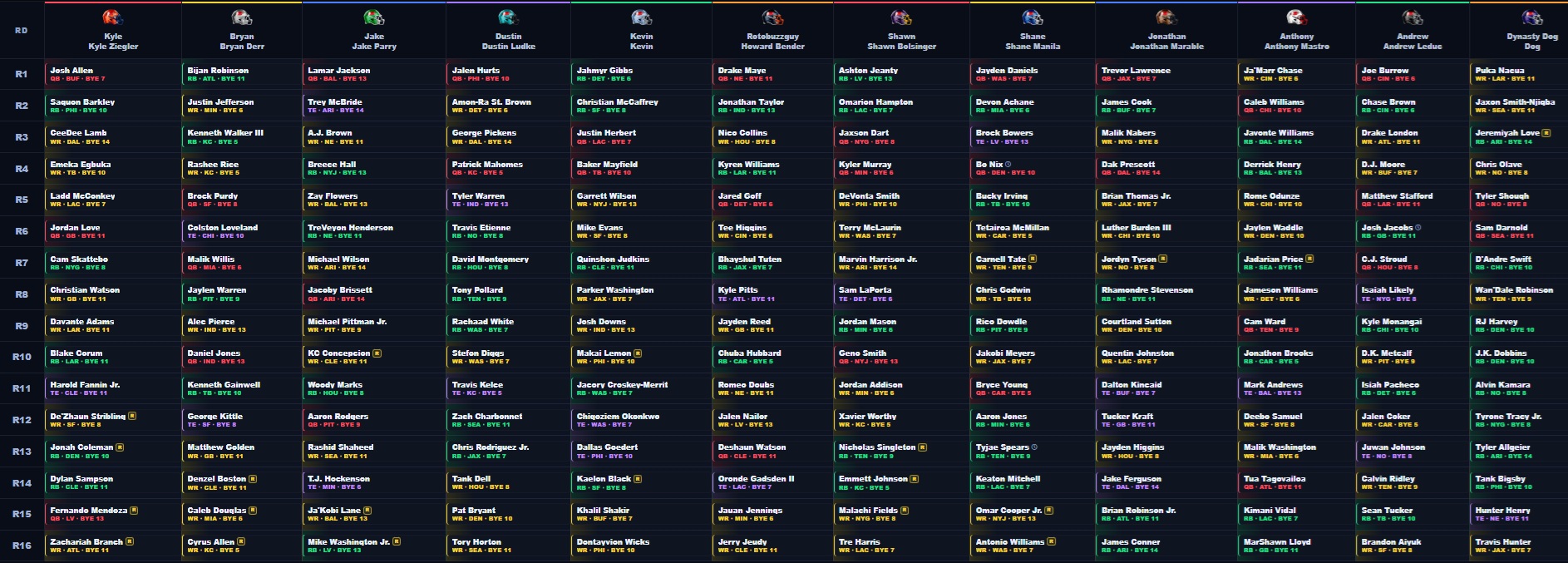
Key Takeaways from Our Expert Superflex Mock Draft
Having done hundreds of mock drafts using the Fantasy Alarm mock draft simulator, including the Perfect Draft Series here in the Draft Guide, nothing really surprises me when the fantasy experts step into a 12-team PPR superflex mock draft. Superflex is QB-loaded at the top. Yes, you will see some analysts actually wait on the position, but walking into this draft, I expected most, if not all, of the room have two quarterbacks by the end of four, maybe five rounds. I wasn't too far off, so let's break it down for each position.
- Drafting QB: Unlike single-QB industry mocks, this draft board is a far more accurate reflection of what you'll see in a Superflex home league. Managers will grab top-tier QBs in the first round while others scoop up elite running backs and wide receivers. Round 2 shifts heavily back to RBs and WRs, setting up Rounds 3 and 4 for another run on quarterbacks. By the end of Round 5, eight of the 12 teams had already drafted two QBs. In a typical home league, that number will likely be 10 or 11, so adjust your strategy accordingly. Rostering a third QB is a smart move, but don't overvalue the position—you're drafting a spot-starter for bye weeks, not an every-week anchor.
- Drafting RB: Ten running backs were taken in the first two rounds. Even if your home league goes QB-crazy early, don't count on a massive slide for top RBs. With most managers aiming to build a strong backfield, those who take a QB in Round 1 will immediately target an RB next. While the position gets pushed down slightly, high-end values are still gone by the fourth round.
- Drafting WR: Superflex drafts are where you'll find your best wide receiver values. Elite options slide toward the late first round, and subsequent tiers see roughly a two-round discount compared to standard drafts. Rounds 5 and 6 remain loaded with high-end talent, so don't panic if you don't address WR until Round 4 or 5. Lock in your QBs and RBs first—the receiver value will be there.
- Drafting TE: Brock Bowers and Trey McBride will always go early, meaning they won't fall far enough to represent a true value pick. You might see target options like Tyler Warren or Colston Loveland drop into the fifth or sixth round, which offers decent value, but there's no need to reach. Like the WR position, the tight end group naturally gets pushed down the draft board in Superflex formats.
When Should You Draft Your Second Quarterback?
Timing your second quarterback selection in a superflex draft requires you to read the room and "go with the flow" rather than strictly forcing a pick. You should closely monitor your draft board to see if managers are panicking and reaching early for their second quarterback; if they are overvaluing the position, sitting back allows premium skill-position players to slide directly into your lap. Ideally, your goal should be to secure two starting quarterbacks by the end of the fifth round. Securing your QB2 within that window protects you from a total positional drought while still allowing you to maximize the heavy receiver values that consistently open up in the middle rounds.
Best Superflex Draft Builds from The Mock
Shawn Bolsinger (Pick 7)
To be so bold as to take my two favorite running backs this year and shun the typical Superflex herd mentality of taking early QBs, Shawn deserves some serious props. I actually really like the way he built this team. While I might not have taken on the risk of his specific choices at quarterback, I love how he grabbed both QBs back-to-back and then loaded up on wide receivers and tight ends over the next four rounds. The incredible value available at those skill positions in a Superflex draft shines perfectly here.
Kevin (Pick 5)
Everything I just said about Shawn’s draft, applies here. Plus, it’s Kevin.
Players We Draft Differently in Superflex
When transitioning to a Superflex format, the only position you draft fundamentally differently is quarterback. Because quarterbacks score more points than any other position in fantasy football, the ability to start two of them elevates QB to an absolute priority, pushing elite passers into the top rounds of your draft. Running backs retain virtually the exact same high priority as they do in single-QB leagues, as top-tier backfield volume remains scarce and critical to secure early. Instead, it is the wide receivers and tight ends who naturally slide down the draft board. Because both positions offer significant depth across the mid-to-late rounds, you can intentionally de-prioritize them early on, confident that high-upside receiving value will still be waiting for you further into your draft.
Superflex Draft Mistakes to Avoid
Navigating a Superflex fantasy football draft requires a fundamental mindset shift compared to standard single-QB formats. Because starting a second quarterback yields significantly higher week-to-week baseline scoring, mismanaging your draft strategy can sink your season before it even starts.
The most common Superflex draft mistakes to avoid fall into key tactical traps:
Waiting Too Long on Your Quarterback 1
- The Mistake: Treating Superflex like a 1-QB league and prioritizing running backs or wide receivers in the early rounds.
- Why It Hurts: Quarterbacks offer the highest baseline floor and ceiling in fantasy football. Waiting until Round 3 or 4 for your first QB leaves you stranded with low-upside options while your leaguemates secure elite dual-threat passers. Aim to draft at least one reliable starter in your first two picks.
Failing to Draft a 3rd Quarterback (QB3)
- The Mistake: Stopping after you select your two main starting quarterbacks.
- Why It Hurts: NFL injuries and bye weeks are inevitable. In a 12-team Superflex league, 24 to 36 QBs are rostered, making the waiver wire virtually dry for emergency signal-callers. Having a third starting QB—or a high-upside rookie/backup—provides vital insurance and valuable trade leverage.
Using Standard 1-QB Cheat Sheets or Draft Boards
- The Mistake: Relying on default rankings, overall ADP, or standard positional cheat sheets provided by host sites during live drafting.
- Why It Hurts: Default rankings reflect 1-QB formats where quarterbacks drop to the mid-to-late rounds. Relying on unadjusted cheat sheets will cause you to miss positional runs and misjudge player values in Superflex drafts.
Overvaluing Low-End Quarterbacks
- The Mistake: Panicking during a quarterback run and reaching 2–3 rounds early for a low-tier, pocket-passing QB with a low fantasy ceiling.
- Why It Hurts: While starting two QBs is optimal, forcing a reach on a replacement-level player sacrifices elite talent at wide receiver or running back. In emergency situations, a high-end WR2 or RB2 in your Superflex slot will often outscore a bottom-tier quarterback.
Ignoring Bye-Week Alignment
- The Mistake: Drafting two starting quarterbacks who share the exact same bye week without securing a viable QB3.
- Why It Hurts: You lock yourself into a guaranteed weak week, forcing you to either take zero points in your Superflex slot or make an unfavorable panic trade.
But enough about what I have to say. Let’s take a look at what our invited drafters had to say about their drafts.
Kyle Zeigler, Fantasy Pros - @KZ1180
I was quite pleased drafting from the one spot. After taking Josh Allen at the 1.01, I built the team around wide receivers and an anchor running back. I secured three wide receivers in my top-20. I knew I wanted to wait on my second quarterback and landed Jordan Love in the sixth round.
I was faced with a roster construction decision with Tucker Kraft available to me at 11.12, which is wild in itself. Considering I already had Jordan Love and Christian Watson, I couldn’t put all my eggs, or in this case, cheese, in one basket. Getting Harold Fannin was a nice alternative that I’ll happily take.
Sometimes you have to pivot off your rankings and draft a roster, not just the players. Kraft was the better value, but roster construction matters.
Bryan Derr, Fantasy Alarm - @bryan_derr
Going into this mock, I was pretty excited to start out with the 1.02 overall pick. Sure, it was Superflex, which should change up my strategy a bit, but I haven’t had an opportunity yet to snag one of the top backs in a draft (outside of best ball). I went with Bijan over Gibbs due to the Lions' offensive line continuing to take hits (C Cade Mays is out with an injury for 8-10 weeks).
Admittedly, even for Superflex, the quarterbacks flew off the board a lot quicker than I was anticipating. I had a group of Prescott, Nix, Murray, Mayfield, and Mahomes that I was looking to snag two of, but they all went off the board before me. Then I got sniped again for Jordan Love, who I think went way too late. I still ended up with a QB room of Brock Purdy, Malik Willis, and Daniel Jones, who provide a nice mix of floor and upside.
Otherwise, I loved my draft. Tight ends were staying on the board, so I think I got great value for both George Kittle and Colston Loveland (who WILL lead the Chicago Bears in targets this season). I was able to stack each of my QBs with one of their pass catchers and get insurance on a riskier player like Rashee Rice late. Tons of value down the board overall. I missed out on a couple of my favorite targets like Zay Flowers and Jaylen Waddle, but I can’t complain with the top three teams I think I walked away with. Overall, my favorite draft may have been Anthony Mastro’s (starting with Ja'Marr Chase and Caleb Williams is lethal), but if this were a real league, I think I would have as good a shot as anyone.
Jake Parry, Fantasy Alarm & Fantasy Sports Advice Network - @Parry_FF
Starting at the 3rd pick in a superflex, I'm almost always snagging a QB, and I think Lamar has as much upside as anyone here. After him, the drop off felt steep, especially when someone like Brissett can be had much later so he was a clear QB2 option for me. The WR's/RB's I liked most went, so I took my TE1 in McBride, knowing the drop off from him to Bowers is big, as is the drop off after. I was able to snag 3 WR's who I think can operate as WR1's for their teams, and the RB room I have has elite upside. The value you can get on WR's is absurd, with many guys I'd have been comfortable with in the 10th or earlier being available after, so from there I just targeted upside and handcuffs"
Dustin Ludke, FFToday & Dynatyze - @theDunit13
Seeing that I had the 1.04 meant I was going to get the last of my big 4 QBs: Josh Allen, Jayden Daniels, Lamar Jackson, and Jalen Hurts. Selected Hurts over Daniels.
I was shocked to see running backs going off the board so quickly. Eight went before my next pick. With the value at wide receiver still being there, I ended up unintentionally landing into a slight zero RB build.
It's not my normal build, but I felt it went really well. I was able to snap my favorite running back this year, Travis Etienne, in the 6th round. I've written about his top 5 upside in my July rebuilders digest article. I ended up drafting 4 straight running backs and six in the last 10 rounds.
I was able to score my favorite stacks in Patrick Mahomes and Travis Kelce. Both are undervalued after a down 2025 season.
Overall, the team has more upside, which also means risk. I'm usually a cautious drafter, but the way the board fell to me forced me to go a different route. I'm still very happy with my team and feel the upside players I did draft have a high percentage of hitting. Would make for a very fun team to watch and manage this year
Kevin
He never has anything to say.
Shawn Bolsinger - @Shawn_Bolsinger
So you’re doing a mock draft.
Let me guess. ADP and value picks. Players in certain areas over and over again. Same players, same places, in some sort of positional frequency.
But wait.
Did you know that final piece carries the most importance.
Answer this. Why are you doing a mock draft? I suspect the reply for just about everybody will be to see what players are available during their picks.
What if I told you there is another perspective, mentioned above, that includes that theory but advances your readiness. One more step you are willing to take in order to dominate.
So you’re doing a mock draft.
Mock. Draft.
Try this. Pre determine what positions you will draft and where prior to the draft and stick to it. Do not even look at the other positional players. Draft the position. When you have committed to. It will cost you nothing while gaining structural knowledge.
Another question.
What wins fantasy football?
Simple answer. The best team.
Team.
So why do we focus so much on the player.
Great players are going to be great players. How you put those players together is what makes the team. So build a team.
Sure, recognize the talent. The talent in your expanded range. For the position you are drafting.
Here is an example.
Commit to
rb, rb, wr, wr, wr, rb, qb, te, wr, qb, rb, wr, wr, rb, te, rb, wr, wr, k, def
Expanding your range would be this. Your first two picks will be studs so best available rb,rb.
Then in round 3 you start a wr run.
That group of players starts in round 3 but does not end in 5.
Instead include every wr from 3 to 9! Remember, rounds 6, 7 and 8 are predetermined to rb, qb and te. So any wrs you prefer over others in those spots will not be available there. If it is someone you feel has more value than another anywhere in that range draft them now. Continue using the expanded range for every positional change rest of way.
So you’re doing a mock draft.
Create many paths. Follow each to its end. Build your favorite team. Then do it again.
On draft day.
The above strategy/article was used complete in our mock draft.
- In the end I feel pretty good about it.
- 2x dual threat running backs
- 2x mobile quarter backs
- 3x first read wide receivers
- 1 bounce back good spot tight end.
- A primary of committee rb3, safe floor qb3, 4 high upside spike week wrs and 2 rookie rbs in potentially viable spots.
All of which have great bye week separation and coverage.
I am not fond of 3 players from one team however. Nor completely comfortable with my solo tight end. But I do feel LaPorta is in a great scheme and hopeful for a big return.
Shane Manila, Dynasty Trades in 5 - @shaneistheworst
My objective in the early rounds of this mock draft was to maximize positional leverage by exploiting the 4-point passing TD format with rushing quarterbacks. At 1.09, the plan was to go running back unless an elite dual-threat QB fell into my lap. When Jayden Daniels was available, I pivoted immediately to grabbing my anchor QB before doubling back in Round 2 for De'Von Achane to secure a top-five RB.
Rather than forcing wide receiver early in a start-three WR format, I decided to wait on the position after the elite tier was off the board. The wide receiver market flattens out significantly past the top tier, making it easy to hunt top-20 production in the middle-to-late rounds without reaching in early rounds. That patience let me gain a positional edge at tight end with Brock Bowers in the third round, then double down on quarterback rushing upside in the fourth with Bo Nix, who finished 11th in QB rushing yards in 2025.
It was important to stick to the plan through the early rounds and I was rewarded with being able to secure my WR code in the middle rounds.
Jonathan Marable, Da Fantasy Football Show - @jonymaine37185
In this draft, my plan was to snag two quarterbacks in the first four rounds. I’m feeling like there’s some good value at almost every position this year in SF leagues. I managed to grab two quarterbacks who are key players for their offenses—T-Law and Dak. I also picked up a running back in James Cook with top-five potential and two wide receivers who used to be teammates, which should give us great return on investment at the position. I usually like to take Parker Washington later in the draft, but maybe I went a bit too early on BTJ, so I had to make sure our wide receiver room had some upside and reliable players. Getting Luther Burden after Rome was a real treat. Jordan Tyson is the player I’m not telling my friends about that I want to leave every draft with. I think N.O. is one of the best places to find fantasy assets this season. They play fast, and Kellen Moore is really doing well with his playmakers all over the field. Jordan Tyson is just one Olave injury away from being the best pick made in drafts. I know he has his own injury history to deal with, but his price is better than Olave’s.
Dre Stevenson was a top-10 running back in the NFL when he was playing against stacked boxes, so AJ Brown fixes that, plus Mike Vrabel is committed to him, so he’ll still have a role. At RB 2 in RD 8, I’m completely fine with that. After that pick, I went for two number-two options on offenses that we expect to be elite in LAC and the Broncos with Quintin Johnston and Cortland Sutton. Then, I got great value at tight end with Dalton Kincaid and Tucker Kraft. In deep leagues, double-tapping on tight end is the way to go this season, in my opinion in deeper drafts or drafts that have multiple flex options . RD 11 & 12 for those picks. Jayden Higgins was the last player I felt great about getting in RD 13. So, I focused on making my wide receiver as deep and talented as possible, along with having players on good offenses. I think I accomplished that.
Anthony Mastro, DrRoto.com - @MastroBall
Picking from the 10 spot, my strategy going in was to grab a QB in the first two rounds and then hopefully get my second QB in round 5.
Knowing I was picking #10 and #15 overall, I made a list of the top 15 players that I would want to start my team with, including 7 QBs. I was willing to double tap QB if the room was going to wait on the position.
Chase and Caleb were a solid start, I was happy for a brief moment.
The plan for the top 8 rounds was to get my 2 QBs, 2 anchor RBs and 4 WR1s (or 3 with a premium TE if I could get one)
Rounds 3 & 4: Javonte and Derrick Henry (who felt like a steal, despite this being a PPR league). Now I need that second QB.
I knew waiting until the 5th round would be risky because there was a chance I would have to reach. The last QB on the target tier was Goff and you grabbed him a few picks before me, so I pivoted to Odunze and Waddle to build towards my 4 WR. Now I was in trouble.
I was hoping Malik Willis or Love would make it back for my 7th pick, and that didn’t happen so I grabbed Price as my 3rd back, so much for Plan A.
At that point I resigned myself to waiting on QBs and knew it was going to be ugly. But I could save it with a solid core of RB and WR and hopefully an upper tier TE.
Then Howard took Pitts right after LaPorta, which tanked that plan. I’ll now wait for TE like I usually do.
Plan C, let’s grab some guys with league winning upside, hence the pick of Jonathan Brooks when Chuba was still there, as my top bench player. Then I went on to draft Deebo Samuel instead of Matthew Golden, I just couldn’t resist him back with Shanahan and he’s not as old as most think. He’s locked in as a starter as long as he’s healthy and he’s an easy start during bye weeks.
Mark Andrews over Tucker Kraft was also probably questionable, but I just don’t trust guys coming back from ACL tears until I see them play. Andrews feels like a safe bet to get near 10 touchdowns since they just don’t have any big red zone targets (other than Ja’Kobi Lane, who I wanted late, but that didn’t happen either). Again, if I was swinging for upside, Kraft would have been a better pick. So much for “swinging for upside”.
The last 2 picks of Vidal and Lloyd are handcuffs that I was surprised lasted as late as they did, considering we just heard the “Mike McDaniels nonsense” and the “Josh Jacobs might get punished this season after all” news today.
Quick notes:
- I was shocked some WRs lasted as long as they did, like AD Mitchell was undrafted (makes no sense to me to take Travis Hunter or Tank Dell over him, but what can you do)
- I thought team 1 had a very good draft. Adams and Watson at the 8/9 turn as his WR4 and 5 was solid. Players just fell to him nicely.
- The team picking after me grabbed his 3rd QB too early when he could have taken a 3rd back like Swift or a 3rd WR. I don’t love Metcalf as a WR3 in a ppr league.
- Howard did a great job sitting in the middle and taking what came to him. Maybe a little thin on WR, but you have a great QB duo, an elite TE (I believe in Pitts) and a solid stable of backs. I love Nailor for where he is going this year. He’s going to be a solid WR3-4 type player.
Some other notable players that fell:
- Parker Washington in the 8th
- Croskey Merritt in the 11th
- Goedert in the 13th (like him better than Chig in the 12th, especially with Diggs now there and with Tunsil hurt, he may have to block more)
The Fantasy Dog, Dynatyze - @Dog_FF
I really enjoyed drafting on a different site than I’m used to. Made the ADP jump and certain players rose and fell where I have not typically seen that happen. I drafted from the 1.12 spot and faced a lot of tough decisions. In a world full of superflex junkies I decided to punt the QB position until later. I have found that there is so much value in waiting on QBs, I may have waited a little longer than I should have but I like how my roster turned out.
Starting any draft off with Puka Nacua and Jaxon Smith-Njigba at the 1-2 turn feels like a win in any format. Rounding out my first 4 rounds with Chris Olave and Top 3 NFL draft pick Jeremiyah Love was fun. I’ve been very high on Love and apparently the NFL was too with countless sources stating Jeremiyah Love was the best player in the 2026 draft. RB’s drafted in the Top 10 of the NFL historically smash in fantasy football.
I found myself making sure to get some of “my guys” in this draft. JK Dobbins was a priority and I was happy to draft his receiving counterpart RJ Harvey alongside him. When healthy Dobbins has been great….key words “when healthy”. Was thrilled to be able to stack Tyler Shough and Sam Darnold with JSN and Olave. Also got one of my favorite late round TE picks in Hunter Henry who just signed a 2-year extension with the Patriots. Drake Maye keeps his best bud and reliable red zone target. Was my first time drafting Travis Hunter in a while but someone has to take him right? If any of the players who only play WR were to miss time Hunter feels like a reliable option. Was happy to get my RB1 handcuff with Tyler Allgeier. Feels like he will be a TD vulture similarly to his role behind Bijan Robinson during Robinson’s rookie year. My biggest regret was drafting so many bench RBs…somehow someway I thought there was an additional starting flex spot. Dumb dog!
Andrew Leduc, TSS Fantasy - @andrewleduc_tss
Round 1 - (1.11): Joe Burrow
To no surprise, given this is a Super Flex draft, quarterbacks started coming off the board early and often. What surprised me was that I was able to draft Joe Burrow as the 7th QB off the board with the 11th pick. You will see with my next pick why this stroke of luck shaped the first few rounds of my draft, but sandwiched around my pick was teammate Ja'Marr Chase at the 10th pick and Puka Nacua at the 12th pick.
Now, outside of having the 12th pick turn, it would be pretty tough to stack both Burrow and Chase in this format. Getting Burrow where I got him felt like a big win. I understand Allen going first and Lamar Jackson, Jalen Hurts, and Drake Maye being the 2nd, 3rd, and 4th QBs, respectively, but the next two going before Burrow surprised me.
At the 8th pick, Jayden Daniels came off the board and was immediately followed by Trevor Lawrence. Once again, the format dictates needing at least 1 stud QB, so I am not saying I do not understand these two guys being drafted in the 1st round. My only surprise here was that they went before Burrow, who, when healthy, is easily a top-5 QB. You can make the argument that, at full health, Daniels and Lawrence may not even be top-10 guys. We have seen both of their ceilings and we have seen both of their floors (may be a little unfair to Daniels, but still). Joe Burrow has an improved offensive line, two stud receivers in Chase and Higgins, and a running back who caught 69 passes for 437 yards and 5 TDs last year. That was good enough for 5th amongst RBs in catches and 6th in receiving yards. Burrow has QB1 upside. I don’t seen Daniels or Lawrence having that type of potential at this stage of both of their careers.
Round 2 (2.02): Chase Brown
Admittedly, my second pick was a reach from the standpoint that the RBs taken immediately after Brown were James Cook, Devon Achance, Omarion Hampton, Jonathan Taylor, Christian McCaffrey, and Saquon Barkley all in the 2nd round. But for every reason I just mentioned above for Chase Brown’s role in the Bengals offense with Joe Burrow, was exactly the reason why I wanted to lock in a stack that would score me points on probably 95% of the Bengals TDs this season. I can admit the reach in the vacuum of comparing him to talent drafted around him, but I will stand by the strategy even though I held back on taking some other guys I have ranked higher.
Rounds 3 & 4 (3.11): Drake London, (4.02): DJ Moore
With a QB and RB stack secured, it was time to move my attention to the wide receiver position. I first grabbed Drake London with the hopes of being able to grab Chris Olave coming back around after the turn, but Olave was sniped from me with the 4.01 pick and I instead took a chance on DJ Moore having a resurgence season in an offense that has been desperate for a top receiver ever since Diggs left. There was another run on quarterbacks after my Moore pick with 7 more going off the board in rounds 4 and 5. There were also 3 key WRs I was targeting that came off the board that I was hoping would still be there in round 5 after seeing the flow of this draft. Emeka Egbuka, Ladd McConkey, and Rome Odunze almost made it back to me, with Odunze being taken at the 5.10 pick right before my next pick.
Because I missed on the WR3 I wanted, I decided to pivot here to my second quarterback instead of waiting until after the turn like I had planned.
Round 5 (5.02): Matthew Stafford
I felt good about snagging Matthew Stafford as the QB18, and it was good I pivoted here because at the turn Tyler Shough and Sam Darnold went back-to-back before my next pick. The pivot wasnt because I didn’t think there wasn’t still value at the position later in the draft, but after Stafford I felt like the risk level started to drastically increase. I wanted to lock in a solid starting lineup as soon as possible here.
Remaining Rounds
- Pick 6.11: Josh Jacobs
- Pick 7.02: C.J. Stroud
- Pick 8.11: Isaiah Likely
- Pick 9.02: Kyle Monangai
- Pick 10.11: DK Metcalf
- Pick 11.02: Isaiah Pacheco
- Pick 12.11: Jalen Coker
- Pick 13.02: Juwan Johnson
- Pick 14.11: Calvin Ridley
- Pick 15.02: Sean Tucker
- Pick 16.11: Brandon Aiyuk
Safe Picks
When it comes to the rest of the draft, I feel as though I had a good balance of safe floors, opportunistic upsides, and shots in the dark. Josh Jacobs was a safe floor pick. We will wait to see what this offense looks like and what his health looks like, but he should be at least steady and possibly a good sell-high candidate if this was more than a mock draft. I tend to look for some of those guys in mid-drafts that I know I can plug and play any given week for their floor, but knowing that if they start to hit their ceiling at any point, I could get good value for them on the trade market.
C.J. Stroud was strictly a value pick given where we were in the draft. I felt like a 3rd-string quarterback who is looking to rebound and has the pieces around him to have some ceiling weeks made sense, given Stafford's age and injury history, along with Burrow's injury history. I thought about taking tight end here, but ultimately was still able to get Likely in the next round, which I was very pleased with.
Opportunistic Upside Picks
Kyle Monangai, Isaiah Pacheco, Jalen Coker, and Sean Tucker fall into this category for me. All of these guys can step up if their numbers are called and are in systems that would utilize them as if they were always number-one starters at their positions. You need to take some chances at this point of the draft, and I would rather do that than just blindly take running back handcuffs “just in case.”
Shots in the Dark Picks
These should be clearly obvious. Calvin Ridley and Brandon Aiyuk are two talented guys who I am willing to use picks on to see what the coming weeks bring leading up to the season. If Aiyuk is able to figure out a contract or a trade that gets him back on the field, I don’t mind holding him while he gets back into football shape, especially given how my WR3 position is a little less deep and hopeful than I wanted.
Calvin Ridley may not be a Titan at the end of camp and preseason. He is surrounded by young talent the Titans seem to be wanting to grow with their young quarterback that they are hoping takes another step forward. Couple that with Wan’Dale Robinson who has been a more stable veteran, then you can really start to question if Ridley has a role on this team. There are plenty of teams that would like to bring in his ability as a chance to find gold.
Thanks again to all of our experts for turning out such a quality superflex mock draft. Even you, Kevin.