
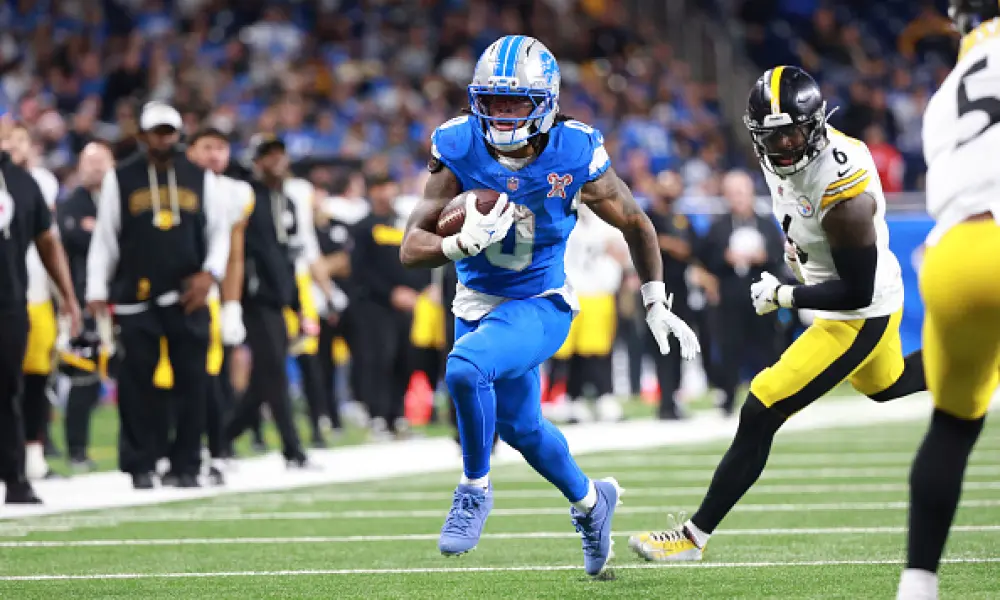

Auction drafts are, in my opinion, the most fun and most skill-testing format in all of fantasy football. Every player is available to every team at all times; the only thing stopping you from rostering Bijan Robinson AND Ja'Marr Chase is your budget. That freedom is exhilarating, and it's also where a LOT of managers get themselves into trouble. Let's make sure that's not you.
This 2026 fantasy football auction draft strategy guide covers budget tiers and dollar values, nomination strategy and how to manipulate the room, and positional pricing for QBs, RBs, WRs, and TEs heading into the 2026 NFL season. Whether you're playing in a $200 standard auction or a keeper-league auction, these auction draft tips and price-tier strategies, built on projected consensus auction values, will help you build a championship roster without blowing your budget in the first hour.
2026 Top-20 Overall Auction Values
Before we get into strategy, let's anchor everything to real numbers. Here's the current consensus top 20 in a standard $200-budget auction. Quick note before we dive in: these dollar values are ESTIMATES, projections based on expected production and standard $200-budget math, not gospel. Your actual room will move based on league tendencies, scoring settings, and plain old draft-day energy. Treat these as a strong starting framework, not a price you're guaranteed to pay or get. These values assume a typical 1QB format, and they're the foundation for every tier and strategy point below.
| $ Value | Player | Pos | Team |
|---|---|---|---|
| $44 | Bijan Robinson | RB | ATL |
| $39 | Jahmyr Gibbs | RB | DET |
| $36 | Jonathan Taylor | RB | IND |
| $34 | Puka Nacua | WR | LAR |
| $34 | James Cook | RB | BUF |
| $33 | Derrick Henry | RB | BAL |
| $31 | Christian McCaffrey | RB | SF |
| $31 | Ja'Marr Chase | WR | CIN |
| $28 | Jaxon Smith-Njigba | WR | SEA |
| $27 | Ashton Jeanty | RB | LV |
| $26 | Saquon Barkley | RB | PHI |
| $24 | Amon-Ra St. Brown | WR | DET |
| $24 | CeeDee Lamb | WR | DAL |
| $22 | De'Von Achane | RB | MIA |
| $22 | Omarion Hampton | RB | LAC |
| $22 | Josh Allen | QB | BUF |
| $21 | Kenneth Walker | RB | KC |
| $19 | Jeremiyah Love | RB | ARI |
| $18 | Justin Jefferson | WR | MIN |
| $18 | Nico Collins | WR | HOU |
(Note: all dollar values in this guide are estimates for a standard $200 auction budget; actual prices in your draft room will vary.)
Look at how RB-heavy the top of this board is; SEVEN of the top 11 dollar values are running backs. That's a massive signal for auction rooms this year; the RB position has both the highest ceiling AND the deepest pool of expensive options. Bijan Robinson at $44 is the clear 1.01 of this entire auction, nearly a quarter of a $200 budget on one player; that's how premium the top of this board is. Notice also that Josh Allen at $22 is the FIRST quarterback on the board, and he's basically tied with several RB2/WR2 caliber players; that tells you everything about where QB sits in the positional pricing hierarchy this year.
Set Your Budget Tiers BEFORE the Draft Starts
The single biggest mistake in auction drafts is winging it. You need to walk in with dollar values attached to players, or at least tiers of players, BEFORE the bidding starts. Otherwise, you're just reacting to the room, and the room will eat you alive.
- Break players into rough price tiers based on the real values above: elite ($30+), strong starters ($15-29), solid starters/flex ($5-14), depth/bench ($1-4). Know roughly how many players you NEED in each tier to fill your roster.
- Budget math: with a standard $200 budget and roughly 16-18 roster spots, your AVERAGE player costs about $11-12. That means every player you pay $30+ for needs a corresponding cheap player elsewhere to balance out. If you spend $44 on Bijan Robinson, that's already more than a third of your starting-lineup budget on one player; plan the rest of your roster accordingly.
- Decide your overall philosophy before you sit down: "stars and scrubs" (a few expensive elite players, fill the rest with $1 bench pieces) versus "balanced roster" (spread your budget more evenly across more mid-tier starters). Both can work, but know which one you're doing and stick to it.
- Run the math on your OWN tiers before draft day: if you're targeting two players from the $30+ tier, that's $60-90 gone before you've filled half your lineup. Make sure your plan actually adds up to roughly $200 across a full, realistic roster, not just your dream scenario.
Nomination Strategy: Control the Board
Who you nominate, and when, is a real skill that most casual managers completely ignore. Use it to your advantage.
- Early in the draft, nominate players YOU DON'T WANT at positions where you're set; this drains other managers' budgets on guys you weren't going to bid on anyway.
- If there's a player you really want, don't nominate him early when everyone's budget is fresh and bidding wars are common. Let him come up later when other managers have already spent down.
- Watch for managers who are clearly going "stars and scrubs", they'll have huge remaining budgets late in the draft. Don't get into bidding wars with them on mid-tier players in the middle rounds; they can outbid you on anything.
- Conversely, if you see a manager who's spent most of their budget early, that's your signal: nominate the players YOU want. Once their bidding power is gone, you'll get them at a discount.
- A great early-draft nomination tactic: throw out one of the $30+ tier names (Robinson, Gibbs, Taylor, Nacua, Cook, Henry, McCaffrey, Chase) EARLY, even if you don't want them. These names are going to command big bids no matter what, and getting one of these auctions out of the way early forces the room to commit serious early-draft capital while your budget stays flexible.
- Late in the draft, start nominating $1-4 tier players aggressively, even ones you don't need. Other managers with thin budgets will be forced to either pass (helping nobody) or spend their last few dollars, and you can often steal a useful bench piece for $1 in the chaos.
Positional Pricing in 2026
Using the estimated auction values above, here's how I'd think about position pricing at the auction table this year, position by position. Again, treat these as directional rather than exact; your room may price RBs even hotter than this or let QBs go even cheaper depending on the tendencies of your specific league.
- RUNNING BACK is where the budget goes. With 7 of the top 11 overall values at RB and a full TEN backs valued at $19 or higher, plan to spend 40-50% of your total budget on your RB room if you want a true RB1/RB2 combo. This is the position where punting early can leave you scrambling for replacement-level production all year.
- WIDE RECEIVER has serious depth, but the gap from the $30+ tier (Nacua, Chase, Smith-Njigba) down to the $18-24 tier (Jefferson, Collins, St. Brown, Lamb, Pickens) is real. If you spend big at RB early, target one of these $18-24 WRs as your WR1 rather than reaching into the $30+ tier and getting top-heavy at two positions.
- QUARTERBACK is genuinely cheap this year. Josh Allen at $22 is the ONLY QB valued anywhere near the top 15 overall, and the position falls off fast after that (Drake Maye at $12, Lamar Jackson at $11, Jayden Daniels at $9). My honest take: unless you specifically want Allen, you can comfortably wait and grab a $5-9 QB later, then put those saved dollars directly into RB or WR depth.
- TIGHT END has a real two-player tier at the top: Trey McBride and Brock Bowers are both valued at $17, well ahead of the rest of the position (Colston Loveland at $11 is the next-highest). If you want a TE who provides a real weekly positional advantage, you're paying close to top-12 WR money for McBride or Bowers. Otherwise, the position craters fast, and waiting for a $1-6 TE is a totally viable strategy.
- Don't be afraid to be the last bidder standing on a player you've targeted, even if it means paying $2-3 more than "market price." The difference between getting your guy and not getting your guy is often just a couple of bucks, and that's nothing in the grand scheme of a $200 budget.
- Save at least $10-15 for the very end of your draft. Endgame auction values can be enormous, sleepers and handcuffs going for $1 that end up being legitimate starters. Don't show up to the endgame broke.
Sample Budget Builds for 2026
Let's put this all together with a couple of realistic roster construction examples based on the estimated values above. These aren't the only ways to build a winning team, and the exact prices will shift on draft day, but they show how the math works in practice and give you a real framework to adjust on the fly.
- THE RB-HEAVY BUILD: Bijan Robinson ($44) + James Cook ($34) = $78 on your RB1/RB2, leaving $122 for the rest of your roster. Pair that with an $18-24 WR1 (Jefferson, Collins, or Lamb), a $5-9 QB, and you've still got plenty left for WR depth and a flier at TE.
- THE WR-ANCHOR BUILD: Puka Nacua ($34) + Ja'Marr Chase ($31) = $65 on a true WR1/WR1B combo, leaving $135 for two RBs in the $15-25 range (think Achane/Hampton/Walker tier) plus a cheap QB and TE.
- THE "PAY THE TE PREMIUM" BUILD: spend $17 on McBride or Bowers to lock in a real TE advantage, then build around one $30+ RB or WR and fill the rest with the deep $10-20 tier at the other positions. This build sacrifices a second elite player for a true positional edge at TE. Only go this route if you genuinely believe in the TE gap.
- Whatever build you choose, stress-test it against the $1 tier too. Every single one of these builds needs 4-6 productive bench pieces from the $1-4 range, and that depth is where waiver-wire-style research before your draft really pays off.