
Fantasy Football Mock Draft: 12 Team Superflex League With NFL Experts (2025)


August is fast approaching, which means REAL fantasy football drafts are here. Best ball is fun and all, but leagues with waivers, trades, and lineups are really what it’s all about. So it’s time to put some of the best ball aside and get some looks at how a real fantasy draft might shake out. The only way to do that is with mock drafts.
We already did a 12-team, single QB mock draft with the Fantasy Alarm Staff and FAmily, which can be found here. Today, we are looking at another expert mock draft - this time a 12-team, PPR, Superflex mock draft with some experts I brought in from the outside. Here is who is drafting with us, as well as the draft order. The names will have their links to their Twitter profiles, and I suggest you give all of them a follow.
- Tyler Orginski - FTN Fantasy
- Jay Felicio - The QB List
- Michael F. Florio - NFL Network
- Jagger May - Fast Draft
- LaQuan Jones - NFL Network
- Dave Kluge - Football Guys
- Eric Balkman - FFPC
- Marcas Grant - MB Fantasy Life
- Mike Faiella - DLF Football
- Jax Falcone - The Undroppables
- Andrew Erickson - FantasyPros
- Andrew Cooper - Fantasy Alarm
In covering this Superflex mock draft, I figured it would be a good idea to highlight some of the different fantasy football draft strategies that were deployed. For each position in our Draft Guide, we have a breakdown of some of the different terms and how the general strategies work. Here, you can see exactly how those strategies are used in action!
Fantasy Football Mock Draft: 12-Team Superflex League Draft Board
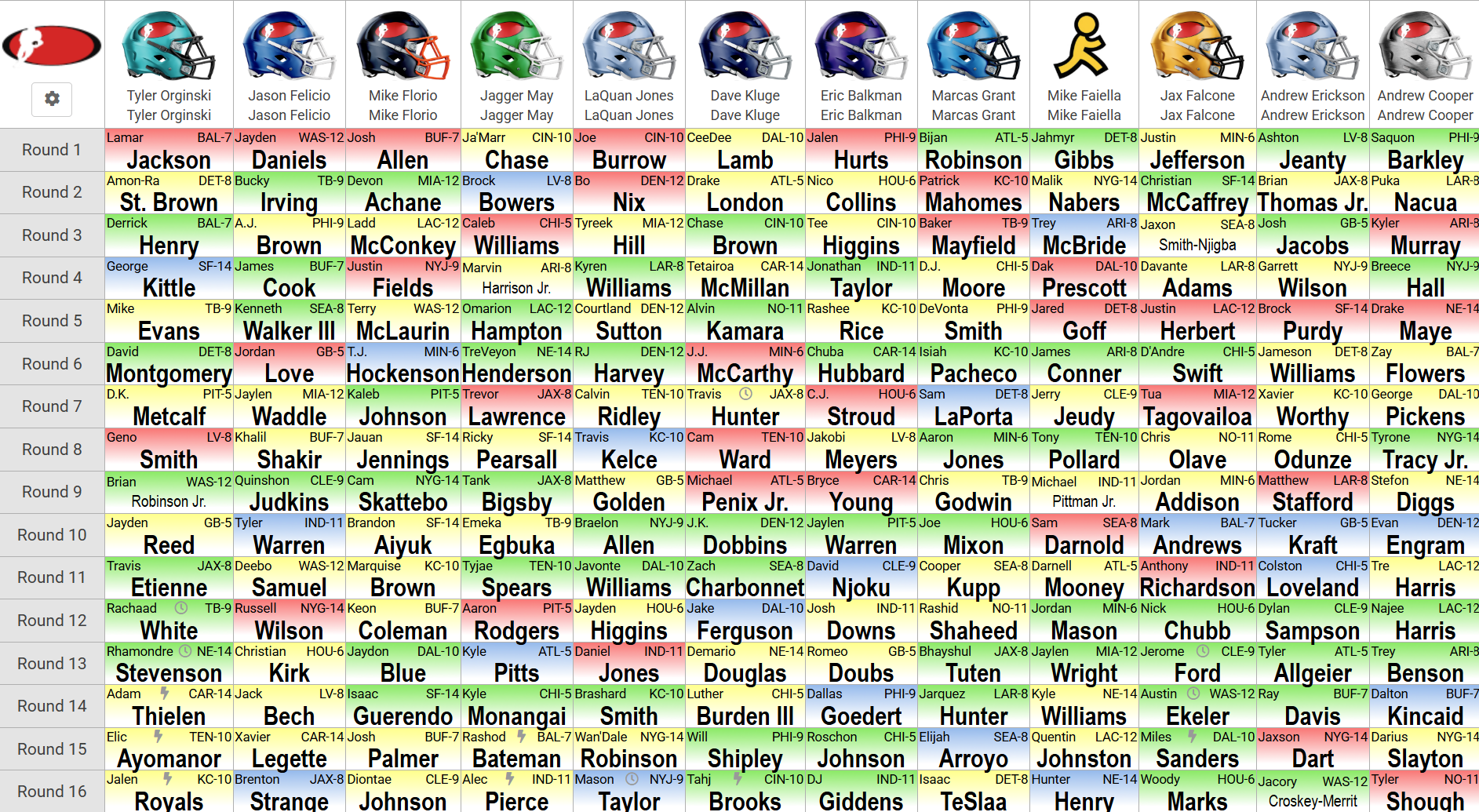
Fantasy Football Draft Strategy: Balanced Builds
Jax Falcone
Value-hawk Jax Falcone let the board come to him here and created a fairly balanced build in his fantasy football Superflex mock draft. He has three target hog WRs in Justin Jefferson, Jaxon Smith-Njigba, and Davante Adams. His starting running backs in Christian McCaffrey and D’Andre Swift, both play in schemes that are friendly to the RBs. And he did that all without sacrificing much at QB and TE, as he still got Justin Herbert, Tua Tagovailoa, and Mark Andrews. The Isaiah Likely news broke right after our draft, so lucky outcome there.
This mock draft is a good example of Jax “reading the room”. He knew that, in an expert draft, tight end would fall and, to some degree, so would the second group of QBs. That allowed him to load up on his starting spots and still grab Chris Olave and Jordan Addison to compete for his flex spot. Since he waited a little on QB, he took an upside stab on Anthony Richardson, then loaded his bench with running backs, where his team is the thinnest. If you only draft two RBs over your first 11 picks, going five straight to close it out isn’t crazy. You will undoubtedly drop a couple, but hitting just one turns a fragile position group of his into a strong one.
Mike Faiella
Mike has perhaps the most balanced team of all of them in this mock draft. He started off with Jahmyr Gibbs and Malik Nabers - perfect early targets in full PPR. Then he got his tight end and QB spots squared away with Trey McBride, Dak Prescott, and Jared Goff. He then attacked the remaining starting spots with James Conner, Jerry Jeudy, and Michael Pittman in the main lineup and Tony Pollard at the flex.
Since his starting lineup is so balanced and he didn’t have a weak position, he also built a balanced bench. He grabbed a mix of ceiling and floor plays in running back and wide receiver. Then he took Sam Darnold as his QB3 and Hunter Henry as his TE2. Hard to complain about such an airtight draft, especially since he took multiple targets of mine like Michael Pittman, Sam Darnold, and Hunter Henry. Anyone who has followed our Scott Fish Bowl Boston drama knows that Mike is notorious for sniping my players. And letting me know about it. Just look at his profile banner on Twitter.
Mike Florio
Florio also went with a balanced build here with his fantasy football draft strategy. He secured his two quarterbacks fairly early in Josh Allen and Justin Fields - he is a massive Josh Allen fan, so he must have been pumped to get him at 1.03. He grabbed a reliable tight end in T.J. Hockenson in the sixth round. And he grabbed some core players early with De'Von Achane, Ladd McConkey, and Terry McLaurin. Where his draft really shines is getting Kaleb Johnson and Jauan Jennings for his RB2 and WR3 spots at good values. These guys are presumed starters in friendly schemes, and he locked them down in rounds 7 and 9.
Given the strength and safety of his starting lineup, he then turned around and threw caution to the wind with guys like Brandon Aiyuk, Keon Coleman, Joshua Palmer, Cam Skattebo, and Jaydon Blue. None of those players need to start right away, so the risk doesn’t matter. Playing it conservatively with the early part of your draft gives you a license to kill with upside stabs in the second half, and Florio gave a perfect example of how to do it. He even stacked two bench WRs with his QB for extra leverage and two shots at landing a full-time starting job alongside Josh Allen.
Fantasy Football Draft Strategy: Hero QB
Tyler Orginski
Tyler was the number one ranker on Fantasy Pros in 2024, so it’s worth noting that he started us off with Lamar Jackson, not Josh Allen. He then focused on building a balanced lineup going WR, RB, TE with Amon-Ra St. Brown, Derrick Henry, and George Kittle. He filled his remaining starting RB slot with David Montgomery and his WR3 spot with DK Metcalf. In round 8, he then finally took his second QB, which is fairly late for a Superflex draft, but he still got a guy with both a solid floor and decent upside in Geno Smith.
Typically, when I go with a “hero QB” type play, I like to take a third stab at a QB. Guys like Sam Darnold, Russell Wilson, or Aaron Rodgers were there for him if he wanted to go that route. But getting someone as good as Geno Smith as late as he did didn’t make that a necessary play. Instead, he opted to load up on upside plays at RB and WR. It’s absolutely a viable approach that way, especially since none of the Browns QBs were drafted, and he can potentially spend up on the wire for whoever is named starter there.
Fantasy Football Draft Strategy: Robust QB
LaQuon Jones
No one truly went “Bully QB,” where, in Superflex, you draft three high-end QBs. But LQ did use the popular Superflex fantasy football draft strategy of taking two quarterbacks with his first two picks. With Joe Burrow and Bo Nix, he got two guys who were both top 7 in fantasy last year. If that happens again, he’ll be sitting pretty.
He then turned around and filled all his main starting spots. The Rams fan got his guy, Kyren Williams, along with RJ Harvey, a great PPR pick in Joe Lombardi’s offense. He took Tyreek Hill, Courtland Sutton, and Calvin Ridley as his starting WRs. Then he was still able to get a steal on Travis Kelce in the 8th round. With his next few picks, he loaded up on upside plays to try to hit on a flex spot with guys like Mathew Golden, Javonte Williams, Jayden Higgins, and Brashad Smith. He even circled around to take Mason Taylor in the last round for some TE upside. Some folks think Travis Kelce is a “boring” pick this year, despite him catching 97 passes while missing a game. LaQuon not only managed to get him in the 8th, but he still threw a little late Yin & Yang TE on there with some late-round upside. Really strong draft.
Marcas Grant
Marcas Grant also decided to lean into the format with a heavy QB, but he actually got Bijan Robinson in the first round before double-tapping Patrick Mahomes and Baker Mayfield. The room letting Baker slide to the third round could prove to be a costly mistake. Those are two guys you can set and forget for the whole season, barring an injury. He then snagged Sam LaPorta at tight end but also circled back later for popular upside pick, rookie Elijah Arroyo, for good measure. QB and TE are all set.
He grabbed two WRs in DJ Moore and DeVonta Smith, who will be in his lineup all year long. His starting running backs are Isiah Pacheco and Aaron Jones, who should be fairly “safe,” so he did the smart thing and took some high-risk, high-reward values in Joe Mixon, Bhayshul Tuten, and Jarquez Hunter. Same with his WR spot - Chris Godwin might not be ready to go Week 1, but he’ll have Cooper Kupp ready to go in full PPR. Marcas’s draft is a good example of balancing safety and upside with your bench.
Fantasy Football Draft Strategy: Late QB
Dave Kluge
“Zero QB” in the sense of not taking a single starting QB is not really a viable strategy in Superflex. Unlike RB, there aren’t really viable “handcuff plus” QBs, so you can’t just take Jaxson Dart and Shedeur Sanders and cross your fingers. Kluge flew about as close to the sun as you should, waiting until the sixth round of a Superflex draft to take his first QB. He quickly made up for it by drafting JJ McCarthy, Cameron Ward, and Michael Penix all in rapid succession. Yes, they are unproven guys, but if two of them hit, he’s golden. If all three hit, now he has trade bait. As Howard Bender likes to remind us, he also doesn’t HAVE to start at QB at the Superflex spot.
Taking this route allowed him to fill his WR, RB, and FLEX spots early with stars like CeeDee Lamb, Drake London, Chase Brown, and Alvin Kamara. He went for some upside with the rookies Tetairoa McMillan and Travis Hunter. He took Jake Ferguson as his only tight end in round 12, which isn’t a bad pick as your starting tight end, but I would have liked to see him add more upside via a second tight end later. The addition of George Pickens, along with his lack of high-end speed, kind of caps the ceiling for Ferguson. There would always be the waiver wire, though, if this were a real league.
Fantasy Football Draft Strategy: Zero RB
Jagger May
No one in this draft went truly “Zero RB” as everyone took at least one back within the first five rounds. But Jagger certainly came the closest. And, while squaring away most of his starting spots early with guys like Ja'Marr Chase, Brock Bowers, and Caleb Williams, he went with the most aggressive build of the group. As Jagger said in the chat during the draft, he loves “building a dynasty team in redraft” and taking a bunch of his favorite rookie breakout candidates.
When you look at his running backs in Omarion Hampton, TreVeyon Henderson, Tank Bigsby, Tyjae Spears, and Kyle Monangai, none of them are guaranteed starting roles. He faded the position a little bit then bet on the talent, hoping at least a couple could hit. Rookies can take some time to carve out a role, but he’s solid enough at all of his other positions that he can piece it together while keeping an eye on the wire. Even if they don’t “start”, Hampton and Henderson should be involved right from the rip, especially on pass downs, and this is a PPR format.
Fantasy Football Draft Strategy: Hero RB
This strategy was not utilized as everyone had multiple RBs by the 7th round. Florio probably came the closest with his second RB being rookie Kaleb Johnson.
Fantasy Football Draft Strategy: Robust RB
Jay Felicio
Jay was the only one who had three RBs on his roster before the 8th round. And he actually did it by the 5th round, selecting Bucky Irving, James Cook, and Kenneth Walker. Those three would be in his two RB spots and his flex for the majority of the season. At QB, he has Jayden Daniels in the main QB spot and Jordan Love manning the Superflex, so really strong there as well.
Because of the heavy RB and QB early, he needed to make up ground at WR and TE. He took AJ Brown, Jaylen Waddle, and Khalil Shakir as his top three WRs. With an RB in his flex, he correctly spent most of his bench trying to improve that WR room. He also quietly deployed a little Yin & Yang tight end as well, taking the high-risk, high-reward rookie Tyler Warren first, then circling back for some safety in Brenton Strange, who will be in the Cade Otton role. No one says you have to draft the safe tight end first - we got Yang then Yin all the time as well.
Fantasy Football Draft Strategy: Bully Tight End
This strategy was not deployed here, but the idea is to take two high-end tight ends and either start one at the flex or trade them. In leagues with a single flex spot, this strategy does hurt your flexibility, so I don’t love it in this format.
Fantasy Football Draft Strategy: Yin & Yang Tight End
Eric Balkman
Balky also did a bit of a “hero QB” build here, like Tyler Orginski, after taking Jalen Hurts in the first round, though he did spring for C.J. Stroud to stack with Nico Collins in the 7th. I do like that he added the third QB in Bryce Young in the 9th as well. Eric loaded up at WR early but still got two rock-solid starting backs in Jonathan Taylor and Chuba Hubbard.
Where he created leverage was waiting to draft his first tight end in the 11th round. He deployed a bit of a “Yin & Yang” tight end approach, this time drafting the risky “Yang” tight end in David Njoku first. Njoku is obviously a solid player, but the risk comes from the complete uncertainty at QB on a team that Vegas has set to win 4.5 games. He circled back with a safe but perhaps a little boring “Yin” option in Dallas Goedert to give him a decent floor. We often describe Goedert as a “double handcuff plus,” where he has some standalone value with big upside if either AJ Brown or DeVonta Smith gets hurt. Textbook deployment of the strategy because he loaded up on every other position first and very likely has the solution at tight end on his roster already.
Andrew Erickson
Andrew Erickson also used the tight end position to create leverage by waiting until the 10th round. He was able to fill his two QB spots with Brock Purdy and Matthew Stafford. His two running backs in the starting lineup are awesome in Ashton Jeanty and Josh Jacobs. Brian Thomas Jr and Garrett Wilson will be in his WR1 and WR2 chairs all year. Then he basically just has his WR3 spot and flex spots to fill with two of Jameson Williams, Xavier Worthy, and Rome Odunze.
He was able to not only fill his whole starting lineup but also grab a bench WR before addressing tight end. He did so by double-tapping the position in the 10th round. He took the reliable Yin tight end in Tucker Kraft, then immediately went high risk, high reward with the first-round rookie Colston Loveland. Since he went a little thin at running back and quarterback early, he finished his bench off with four RBs and a QB. These guys are professionals.
Andrew Cooper
I was picking from the 12 spot and, as always, I started the first few rounds simply by taking “best available”. I got Saquon Barkley and Breece Hall as my two starting RBs early on. I went for upside with two mobile QBs in Kyler Murray and Drake Maye. After only selecting Puka Nacua at WR in my first five picks, I had some work to do there, so I added the relatively safe Zay Flowers and George Pickens to start for me at WR2 and WR3, followed by upside plays in Stefon Diggs and Trey Harris.
At tight end, I went with my signature Yin & Yang move as well. I first went with the safe PPR option, Evan Engram, in the 10th round. I know that Engram can be low aDOT and target dependent at times, so I then circled back with some high-risk, high-reward with Dalton Kincaid. My RB3 is a risky one in Tyrone Tracy so I took Najee Harris before going upside with Trey Benson. In the last round, I figured why not take a look at rookie QB Tyler Shough of the Saints and hope he wins that starting job for Kellen Moore. Kyler Murray doesn’t have a bye until Week 8, and Drake Maye doesn’t until Week 14, so I have some time to see how that pans out.