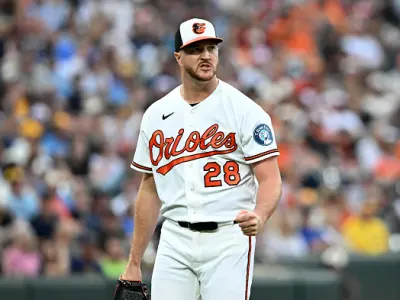

Left-hander Trevor Rogers and the Chicago Cubs are in agreement on a five-year, $120 million contract, ESPN's Jeff Passan reported early Tuesday, November 24, after MLB Network's Jon Morosi first broke the news late Monday night. Passan said deferrals will bring the net present value down slightly. Rogers, 29, spent the last two and a half seasons with the Baltimore Orioles and is the first starter the Cubs have added in a winter that opened with their entire season-ending rotation on the open market. The deal is pending a physical, and the club has not confirmed it.
A $120 Million Deal That Costs Less Than It Sounds
| Player | LHP Trevor Rogers, 29 |
| Team | Chicago Cubs (from the Baltimore Orioles) |
| Contract | Five years, $120 million (about $24 million per year) with deferrals |
| Deferrals | Reported to lower the net present value slightly; salary and deferral structure not yet reported |
| Escalators | An escalator package was reported by 670 The Score's Bruce Levine |
| Draft pick impact | Cubs forfeit their second- and fifth-highest 2027 picks and $1 million of international bonus pool money |
| Status | Agreement reported by MLB Network, The Athletic and ESPN; pending a physical and not confirmed by the club |
Terms per MLB Network's Jon Morosi, The Athletic's Ken Rosenthal, ESPN's Jeff Passan and MLB Trade Rumors.
The headline number puts Rogers in rare territory for the franchise. He is in line for the third-richest free-agent contract for a pitcher in Cubs history, behind Jon Lester's six years and $155 million and Yu Darvish's six years and $126 million, and it is the club's first nine-figure pitching deal since Darvish signed in 2018. The average annual value of $24 million is modest next to the $50 million Tarik Skubal received from the Mets a day earlier, and MLB Trade Rumors noted it would push Chicago's 2027 payroll projection to only about $168 million.
The deferrals matter. North Side Baseball estimated the modest deferrals pull the net present value down to roughly the $23.15 million qualifying offer Rogers turned down from Baltimore, which puts the real cost per year closer to the price of a one-year deal than a $120 million figure suggests. The price of signing a qualifying-offer free agent still shows up elsewhere: the Cubs forfeit their second- and fifth-highest picks in the 2027 draft and $1 million of international bonus pool money.
A Rotation Rebuilt From Scratch
Chicago's top priority this winter was always starting pitching. The entire rotation that finished the season hit the open market, and the Cubs showed early interest in Rogers, the top left-handed option on the market behind Skubal. The club also reportedly agreed with Japanese slugger Teruaki Sato on Monday, which means the lineup and the rotation both got their first major additions within hours of each other.
Rogers is expected to join a group that includes Justin Steele, Edward Cabrera, Braxton Garrett and Javier Assad, according to the New York Post. That is a rotation with depth but no established ace, which is exactly the kind of staff a lefty with Rogers' ceiling could lead if his best version shows up. The timing also reflects the calendar: with a lockout expected to begin in about a week, teams have been moving quickly to finish business before transactions freeze.
The Second-Half Version of Rogers
Rogers finished 2026 with a 4.03 ERA, a 1.185 WHIP and 157 strikeouts against 39 walks over 169.2 innings and a career-high 30 starts. He set career bests in starts, innings, and strikeout-to-walk ratio and tied his career high in strikeouts, which is a solid line but not the one that earns $120 million on its own.
The case for the contract lives in the split. After a rough April and May, Rogers posted a 2.90 ERA with a 24.8 percent strikeout rate from June through the end of the regular season. The Cubs are betting that he is much closer to that pitcher than to the one who struggled early. Over seven major league seasons with the Marlins and Orioles, he owns a 3.88 ERA in 132 starts, and he was an All-Star and the National League Rookie of the Year runner-up in 2021.
The Consistency Question
The risk is the one that has followed him throughout his career. WGN described him as a pitcher who can look like one of the best lefty starters in the game when he is in peak form, but who often is not in that form, and a five-year contract asks the Cubs to bet on the peak. The age works in his favor: at 29, Rogers is a year younger than Skubal and several years younger than most of the other top pitchers on this market, so Chicago is paying for what should still be his prime.
The deal also leans on a split that is a few months long. A strong second half is a meaningful signal, and the Cubs obviously believe in it, but it is still a few months of evidence against a longer track record of inconsistency. That is the entire argument over whether this is a smart investment or a stretch.
What Rogers Means for Fantasy Managers
Rogers moves from the AL East to the NL Central, and he arrives as a mid-rotation fantasy starter with strikeout upside. His 157 strikeouts and 1.185 WHIP in 2026 are useful, and the June-to-October version, with a 24.8 percent strikeout rate and a 2.90 ERA, is the one managers will want to project. The risk is the ERA volatility. A pitcher who posted a 4.03 mark for the season and a sub-3.00 mark for four months is hard to price, so treat him as an SP3 or SP4 with upside and a floor you can live with. A lockout that threatens the 2027 season could also affect draft timing, so keep an eye on the calendar.
Grading the Deal
I give the Cubs a B. They added a prime-age lefty at a price the deferrals make easier to swallow, with an average salary that MLB Trade Rumors said would put the 2027 payroll projection around $168 million. The deductions are the five-year length for a pitcher whose record is uneven, the draft pick and international pool cost that comes with a qualifying-offer free agent, and the fact that the market's best arm went to the Mets. SI's Cubs site gave the deal an instant A, which shows how differently the same risk can be weighed.
What Comes Next for Chicago
Rogers is a first step, not a finish line. The Cubs still need more starting pitching, a second corner outfielder, and bullpen help, and with the lockout approaching, they will have to move quickly if they want to add more before the freeze. After Sato and Rogers, the picture is clearer, but the work is not done.
Check FantasyAlarm.com for continuing free agency coverage and fantasy impact updates.