
Fantasy Football Mock Draft: TE Premium League With NFL Experts (2025)


. Modern day fantasy football circles may believe it to be an archaic tool, but I will continue to champion the use of a quality fantasy football mock draft as a primary aid to your draft prep. You can check out fantasy football rankings all you want, but if you don’t know how to put them into action, what good are they? You’re just crossing names off on a list without proper context. That is why we offer multiple looks at mock drafts here in the Fantasy Alarm NFL Draft Guide.
Nowadays, far too many people replace a quality mock draft with a best ball fantasy football draft, believing it will have the same function. It does not and if you’re drafting in a 12-team season-long fantasy football league, you better have a different strategy than you do for a best ball tournament. And if you’re competing in a league that has some different scoring like a 12-team PPR TE-Premium mock draft, then popping into some random best ball draft. You don’t need to have skin in the game to learn something. Knowledge should be your reward.
2025 Fantasy Football Mock Draft: 12-Team, PPR, TE-Premium
Whether you are playing in a format like The FFPC Big Gorilla or you find yourself trapped with a nutcase like me or Andrew Cooper, TE-Premium is becoming wildly popular. Cut from the same cloth as the PPR scoring concept, TE-Premium is a way to turn an afterthought position into something of value. When there were dominant running backs like LaDanian Tomlinson winning leagues for people, the concept of PPR scoring emerged and began to rise significantly in a very short amount of time. It gave anyone who caught a pass a little bump in value to help level the playing field. Taking it a step further here, in this format, tight ends receiver 1.5-points per reception while running backs and wide receivers till only get one point per catch.
To help understand the impact of a TE-Premium scoring format and how you should potentially adjust your draft strategy, we felt a 12-team mock draft with this scoring would be helpful. I assembled a group of some of my absolute favorites in the fantasy football industry, alongside some of our usual crew here at Fantasy Alarm. I think the results might surprise you!
Fantasy Football Mock Draft Format & Scoring
- 12 teams, 16-round snake draft
- Full-point PPR scoring for RB & WR with the usual touchdown and yardage scoring (no bonuses)
- 1.5 PPR scoring for Tight Ends
- Starting Rosters: QB, 2 RB, 3 WR, TE, 2 Flex (R/W/T)
- Bench: 7 players
Our Fantasy Football Mock Drafters (In Draft Order)
- Jake Parry
- Jim Coventry – Rotowire
- Mike Dempsey – Football Diehards on SiriusXM
- Joshua Hudson – Club Fantasy Football, WOFF
- Bryan Derr
- Jagger May – FastDraft
- Howard Bender
- Bob Harris -- Football Diehards on SiriusXM
- Kevin Tompkins
- Matt Kelley – DraftFaster.com
- Scott Engel – Rotoballer
- Andrew Cooper
Please give everyone a follow and be sure to check out their web sites for all of their work!
The 2025 Fantasy Football TE-Premium Mock Draft Board
The final mock draft board is pasted here but you can also click here to open it in a new window for easier reference.
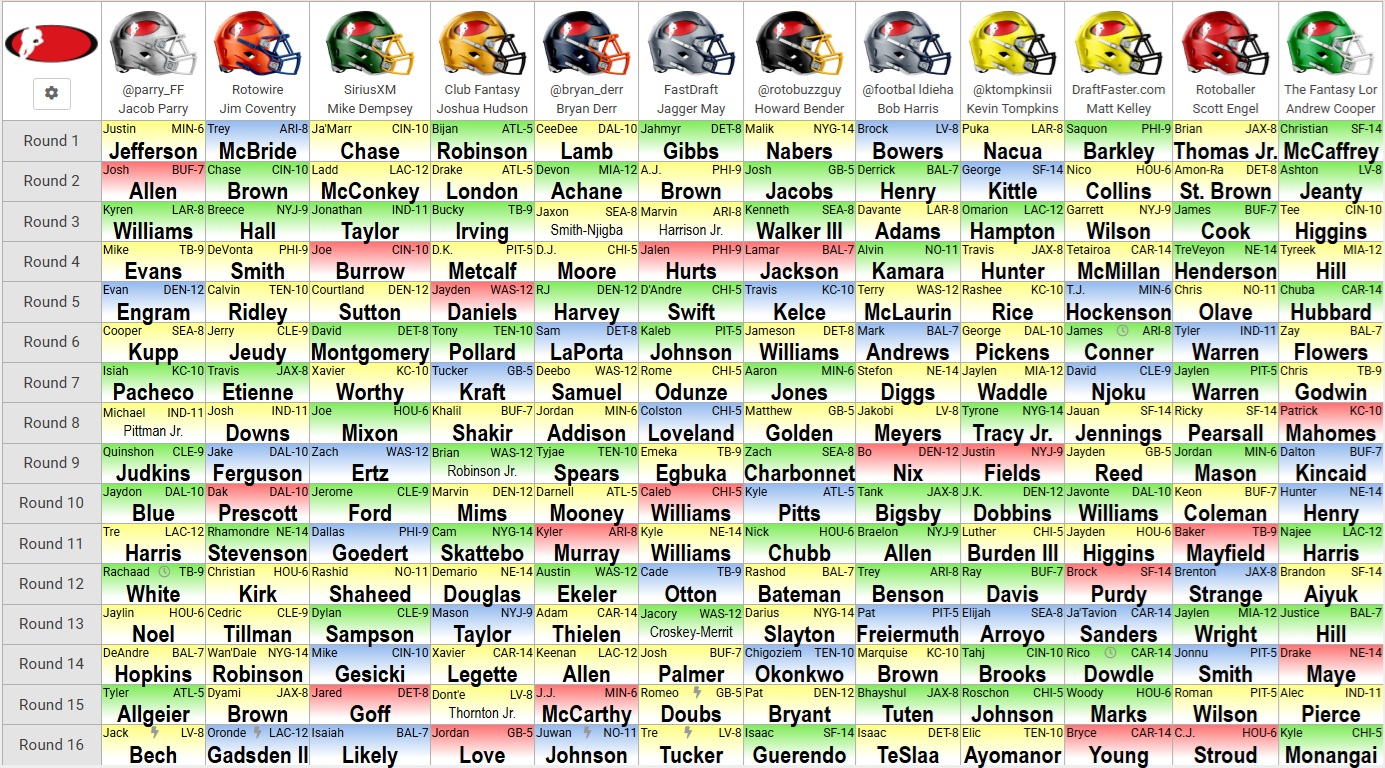
Big thank you to our friends at RTSports.com for allowing me to host this mock draft on their site.
12-Team TE-Premium Fantasy Football Mock Draft Results & Strategy
Oftentimes when we do mock drafts with industry people, the draft board doesn’t always reflect how things are going to go in your home league. If it’s a basic PPR mock draft, many industry people will wait on the quarterback position for an exorbitant amount of time which is a rarity in home leagues. If it’s a supeflex draft, you get the same thing. Industry people are more inclined to wait on their second QBs than the bum-rush you will see in your home league when 20 quarterbacks are gone in the first two or three rounds. For this TE-premium mock draft it’s no different. I think this board is reflective of how things should be but, in all honesty, if you made your home league TE-Premium, you’re more likely to see something like the board in a 2-TE league like the SiriusXM Independence Day Invitational.
Obviously, the difference between a TE-Premium and a 2-TE league is found in both your scoring and your starting rosters. In TE-Premium, you’re still only required to start one tight end. You can use other in your flex spots, but it’s not mandatory as much as it is a way to lean into the scoring. In a 2-TE league, you must start two tight ends each week and the scoring can either be the same for all the positions or yes, you can bump the TE scoring up to 1.5-PPR. In the SXM Independence Day league, the scoring is the same, but you must start two. That’s why you start seeing mid-tier tight ends come off the board even earlier than in TE-Premium.
So, basically, what I am saying is to not overreact with TE-premium scoring because, while each tight end gets a lil’ bump, it does not necessarily increase their values in fantasy; not enough to shoot them up draft boards. Why? Simply put, it’s all about the targets.
Top tight ends like Brock Bowers, Trey McBride and George Kittle continue to stand head and shoulders above the others at the position due to their team target share. We should probably still include Travis Kelce here as well given his role in the Chiefs offense. These guys play the most snaps at their position and they are frequent targets of their quarterbacks and each of them saw a team target share of 20-percent or better. That’s what you’re looking for.
The next wave of tight ends – Sam LaPorta, T.J. Hockenson, Evan Engram, David Njoku and maybe even Mark Andrews with Isaiah Likely on the shelf with a foot injury – should also probably go ahead of their usual fantasy football ADP by maybe a round as they too should see a target share of 18-22-percent as well. But after that, players like Tucker Kraft, Jake Ferguson and Dalton Kincaid can probably be left to where their ADP has them in regular PPR formats. None of them are seeing huge target shares and none of them are going to be posting reception totals that make it worth bumping them up your draft boards.
We may have a few anomalies to take notice of in drafts this season. Hunter Henry may not have killer reception totals from last year, but he saw a target share in excess of 20-percent and should remain a strong red zone favorite of Drake Maye. Kyle Pitts could see an increase in targets this season if they really do plan to use him as a wide receiver like we are currently seeing in training camp. I also have a very strong feeling about rookies Mason Taylor and Elijah Arroyo, but all of these guys, you don’t need to bump them up. Even in TE-Premium drafts, their ADP is fairly similar to what it would be for a regular draft.
As for the other rookies, Tyler Warren and Colston Loveland, for now, I am drafting them in TE-Premium in very similar fashion to regular ol’ PPR drafts. I say “for now,” because I do think they can both see strong target shares, somewhere near the 20-percent mark, based on my research and what we are seeing in training camp and preseason games. Warren looked solid in his debut and Loveland is working his way back from shoulder surgery still, but both are expected to be integral components to their respective team’s passing attack.
As for the other tight ends not named, it’s business as usual and maybe you should consider avoiding in drafts. Guys like Dallas Goedert, Cade Otton and both Pat Freiermuth and Jonnu Smith won’t be seeing a string target share anytime soon. Their offenses just don’t feature the TE position enough for them to make a difference, even with TE-premium scoring.
Bottom line – don’t overrate the scoring. Lean into it with the top guys, but once you get past that top 10, it’s not going to be worth your while. Stay focused on which tight ends have the highest target share and leave the rest to your league mates. Let them waste the draft capital on mediocre production.