


| Age: | 30 |
| Bats/Throws: | R/R |
| Height/Weight: | 6'1", 215 lbs |
| Position: | Catcher |
While perusing early draft average draft positions, seeing Buster Posey lasting until the fourth round in most drafts seems strange. One year removed from being a second round selection in the 15-team format, Posey’s consistent batting average does not hold the same appeal as when he used to hit more home runs. Posey hit a career high 24 in 2012 but he’s been in decline with the lowest total of his career last season during the fly ball revolution and the rumors of a juiced ball.
As a result, his draft price seems much more palatable in the fourth round then his previous levels. In spite of playing half of his games in a ballpark which depresses runs and fly ball effects, will fantasy owners be hesitant to take Posey at his present price point in spite of the reduced cost? Scarcity drives much of Posey’s value due to his production at a position which can be a drain on many fantasy teams due to lower counting statistics and lower batting averages. To be honest, never owned Posey in a format such as the NFBC, preferring to try and find catchers in a good situation with some potential for growth.
Durability proves to be another factor in Posey’s overall value. He’s averaged 146 games played over the last six seasons. Using his statistics from the past three years, Posey slashed .308/.380/.455 with a 10-percent walk rate versus a 10.3 strikeout percentage. He’s one of baseball’s best hitters at a position of need. In spite of the power reduction in terms of home runs, Posey’s recorded the 10th best hard contact of catchers with at least 300 plate appearances the last three years at 34.7-percent. If he’s still hitting with decent exit velocity, what’s causing the home run production to decline?
There’s multiple moving pieces in regards to this question and for starters, diagnosing Posey’s splits seems like an important place to begin. As a primer, here’s a chart noting his splits by halves, where he plays and type of pitcher:

Starting with the halves, it’s apparent Posey starts the season strong either tiring in the second half or not focusing on power. It’s prevalent in his last three year splits by each half and consistent in his career. When getting power from Posey, it’s before the All-Star game. Shifting to his home and road splits, it’s not surprising to see Posey hit for a higher isolated power away from AT&T Park. Especially when rated last in both Fantasy Alarm’s and ESPN’s ballpark effects in home runs allowed.
Daily fantasy players understand how well Posey fares versus southpaws, which the chart punctuates. His slugging and isolated power splits should jump off the chart along with hit being his lowest home run per at-bat ratio. Although the information demonstrates trends in Posey’s statistics, it does not answer any questions about power returning to his game.
Taking the research a step deeper and with the knowledge Posey will not face left-handed pitching on the road enough to reach 20 home runs again, what will it take for him to reach 15, something he’s not accomplished in either of the last two years. Since Posey makes consistent contact and actually improved his plate discipline by cutting his O-Swing (swings and misses outside the strike zone), could it be the way he’s pitched?
In the next chart, focus on the amount of pitches low and away to Posey courtesy of BaseballSavant.com:

Note the high volume of pitches in the first picture highlighted in red. Plus, it also appears in the next chart in pitch location percentage. Even though Posey’s not a pull hitter, in order to try and limit his power, teams work the low and away zone to keep him limited to a singles hitter. Since he’s such a good hitter, this actually works against him. How? Happy you asked. Posey still manages to hit over three hundred in spite of the charts above. But, his power seems to suffer.
Starting with his isolated power, here’s Posey’s career chart from BrooksBaseball.net to illustrate:

Focus on the four boxes in the lower right-hand corner. This appears in red in the savant chart and shows how Posey (nor many major league players not named Vlad Guerrero) can hit these pitches for power. For another frame of reference, here’s Posey’s home runs on balls in play chart from BrooksBaseball as well:
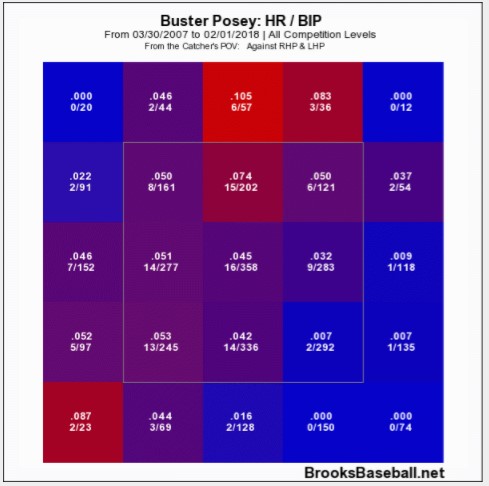
From the second half of 2016 through the end of last season, Posey’s only hit 15 home runs in 206 games. This takes into account 206 games and 742 at-bats. It’s not a small sample. Of course, Posey’s scored 92 runs with 105 RBI which makes him fantasy relevant as a catcher along with a .308/.385/.435 slash line.
Not only does the outside pitch cap his power return, but there’s another culprit. Ground balls. With so many teams transitioning to advanced analytics and preaching to hit fly balls, the Giants as a team, Posey being guilty himself, do not. In fact, as a franchise, they’re going against the grain and hitting more ground balls. Perhaps the home ballpark plays a part in this, but only the team knows for sure.
Since the inception of the second half in 2016, Posey’s half season splits in ground ball percentage: 49.5-percent (2016 second half), 40-percent (2017 first half) and 48.4-percent (2017 second half). With these numbers along with how pitchers worked versus Posey last year, a power drop’s easy to note. Thanks to MLBfarm.com, here’s a spray chart from July 15, 2016 through the end of last season:

And, this one of his plate appearances from this time frame:

Hope can be fleeting but does exist. All of Posey’s advanced metrics seem in line with his career rates. There’s also the news of his new hitting coach, the former assistant with the Astros the last two years. Houston’s one of the teams to buy into advanced analytics and finished 10th in fly balls last year and ranks fifth overall the last three years.
Could Alonzo Powell be a key to Buster Posey hitting for more power? It’s something which will need time to digest, but there’s some merit to the hypothesis. In spite of the home ballpark, San Francisco did finish as the 17th ranked park in terms of doubles while Houston finished 29th. Of course, the short fence in left field at Minute Maid Park produces more homers than two-baggers, but it’s worth noting.
Plus, the Giants seem to be going for it after a disappointing 2017 season and recognizing the cumulative team age coupled with a closing window of opportunity. Could Powell use analytics to induce Posey to hit more fly balls and unlock latent power potential? It may be worth betting on. But changing Posey’s career 46 percent ground ball rate will be a tall mountain to overcome.
Due to the suppressed average draft position this year, Posey’s worth speculating on since hitters with high average seem to be disappearing. Add in his position as a sweetener. It’s a game changer in regards to scarcity compared to relative production. If there’s reports in spring about Posey and other Giants retooling their swings to change launch angles for power, giddy up. Posey becomes even more interesting.
Entering his age-31 season, fantasy owners know enough about Buster Posey to trust his production. Even if the power does not return. But, what if he does find some power as he ages, like many catchers do, and gets back even to the 19 home runs from 2016? With some luck and southpaws on the schedule, perhaps a couple more? Owners do not need Posey to morph into a new level of production, they just need a return to his former ways. A new coach, some new ideas and an adjustment could make Posey a second round player at a fourth round cost. Who knew he could be a discount or even a player to take a gamble on?
This year, for once, it seems like buying Posey seems to make sense, even if it does not look like it on the surface. Buy the 34.7-percent hard contact rate the last three years and note the splits highlighted above. Profit if the power returns. It just might.
---------------------------------------------------------------------------------------------------
Statistical Credits:
Fangraphs.com, Baseball-Reference.com, BaseballSavant.com, MLBfarm.com, BrooksBaseball.net
Player News
{{item.text}}
{{analysis.analysis}}