


I mentioned in my "How to Win Playing DFS Hockey" article that Brett and I are different than most DFS NHL analysts because we take the time to consider line matchups when doing our nightly DFS research.
There his so much more to DFS NHL than selecting players from good teams who play against bad teams. I mean, it’s absolutely possible for a random play to hit, and fairly likely if that random play features a good player. Nonetheless, with pricing getting tighter and tighter, and a seemingly abundance of options with these big 10+ game slates, it would certain behoove you to narrow things down whenever you can.
Last season, war-on-ice.com was the place to go when it came to figuring out line matchup tendencies. This season, I am putting in a good word for the guys at naturalstattrick.com. Through Natural Stat Trick, you can analyze each game by viewing a player’s linemates, and a player’s opposition. Keep in mind, in the National Hockey League, the Road team is required to put five players on the ice prior to each puck drop. The Home team has the advantage because they get the ability to matchup any of their five players with the Away team’s five players. This could force potential mismatches, such as a Home team matching the opposing team’s 4th line with their #1 line.
In general, there are going to be three lines you want to consider for any team. Usually, it’s going to be a #1 or #2 line, but sometimes, #3 lines will get good matchups as well. Most of the time, you can ignore #4 lines because #4 lines will almost always matchup against #4 lines, and regardless, they don’t get enough ice time or power-play time to justify playing in DFS. More often than not, Home teams will match the opposition’s #1 line with their own #1 line. Yes, coaches tend to lack a great deal of creativity with line matchups, but there are definitely exceptions.
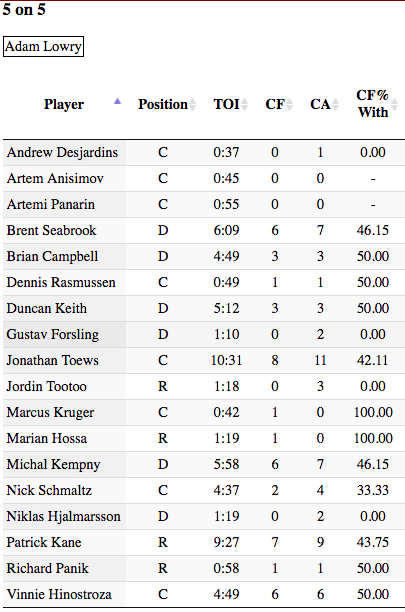
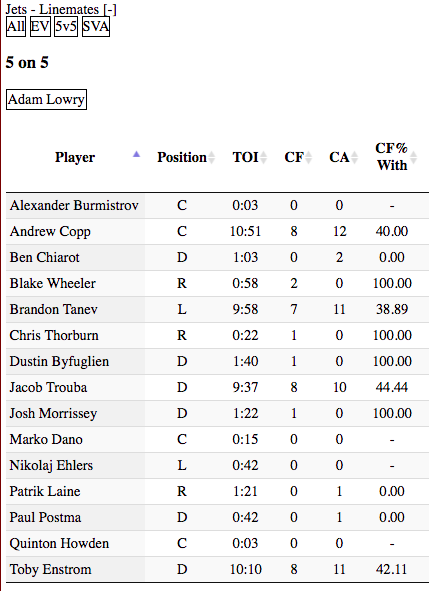
For instance, Winnipeg Jets Head Coach Paul Maurice prefers to matchup the opposition’s #1 line with his 3rd line featuring Brandon Tanev, Andrew Copp, and Adam Lowry. A perfect example of how this situation works out from a DFS perspective is through the Jets game against the Chicago Blackhawks this past Monday.
When it comes to the Blackhawks, it’s clear that their #1 line is the line that features Jonathan Toews and Patrick Kane. On paper, a line with Jonathan Toews, Patrick Kane, and random left-winger is going to be favored against the likes of Brandon Tanev, Andrew Copp, and Adam Lowry. Yes, the end result didn’t work out considering the Hawks got shutout, but Chicago’s top line had the edge from a puck possession standpoint with a 60-40% advantage in CF% (Note: CF stands for "Corsi For" while CA stands for "Corsi Against". The term "Corsi" denotes any type of shot attempt, regardless if it is on net, or gets blocked).
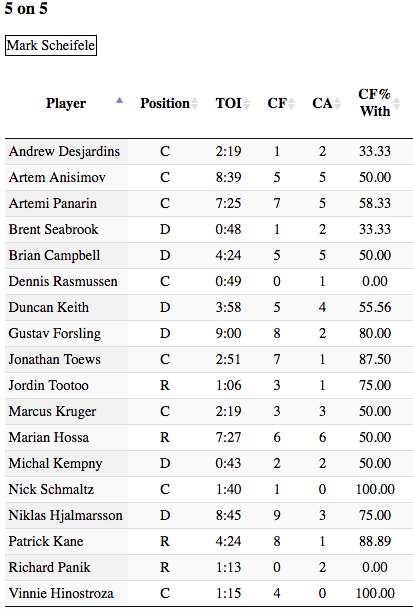
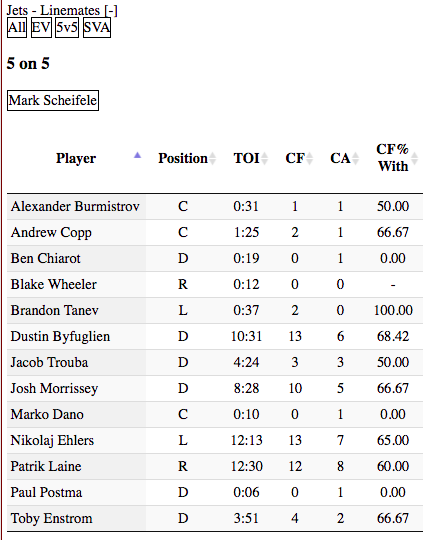
Now, when it comes to the other two line matchups, we know that Maurice will end to play his top line, featuring Mark Scheifele, against his opponent’s #2 line. Scheifele's line with Nikolaj Ehlers and Patrik Laine have been extremely hot, but we know that the Hawks #2 line features Artem Anisimov, Artemi Panarin, and Marian Hossa, so it’s clearly not the best matchup in the world for Winnipeg's top line. It definitely wasn’t a surprise that the possession battle was fairly even throughout the game, but like I said before, skilled players can make things happen. Scheifele’s line ended up scoring two goals, and had the best fantasy production.
And lastly, with Nic Petan and the Jets #2 line likely to matchup against Chicago’s #3 line with Andrew Desjardins, Marcus Kruger, and Richard Panik, there was definitely some value available considering Petan and Marko Dano’s cheap salaries throughout the industry, to go along with their time on the Jets #2 power-play unit. The duo along with Jets Captain Blake Wheeler dominated Chicago's third line throughout the game, and were able to score a goal.
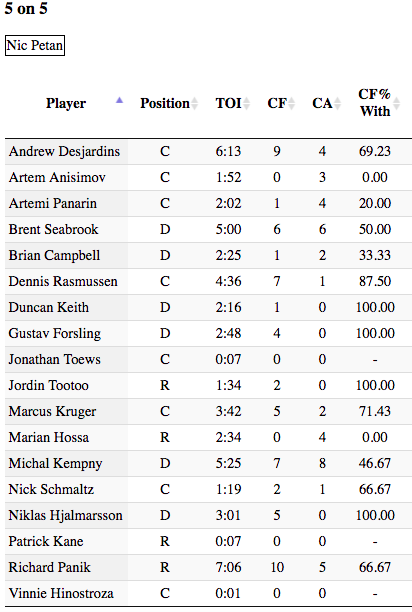
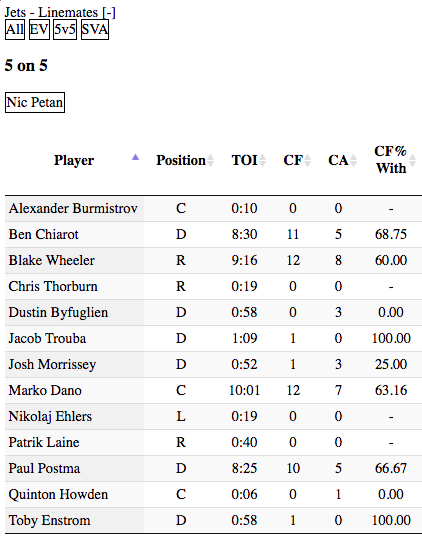
Of course, in order to determine if these plays are viable, you're going to have to do a lot more than just analyze line matchups. Two things that I highly value are ice time and power-play minutes. Lets say the tables are turned and the Jets are playing in Chicago. Brandon Tanev would certainly be cheap, and would likely matchup against the Hawks 3rd line, which is a much better matchup for him than their 1st line. Still, you're not going to see a ton of minutes from Tanev, and you're absolutely not going to see him on a power-play unit.
Certain teams play their top lines a TON of minutes. With forwards, I would quantify the term "a TON of minutes" as anyone who gets over 19 minutes of ice time per game, and sometimes even more. Just a few off the top of my head includes Anaheim, Buffalo, Carolina, Florida, and Winnipeg. This makes players like Ryan Getzlaf, Ryan O'Reilly, Victor Rask, Sasha Barkov, and Mark Scheifele much more valuable.
Conversely, you have Montreal, the NY Rangers, Toronto, and Washington who tend to spread their minutes out fairly evenly. A few of the players from these top lines are almost chronically overpriced because of their lack of minutes, including Alex Galchenyuk, Rick Nash, and Nicklas Backstrom. Still, with someone like Nazem Kadri or Derek Stepan, their pricepoints tend to be reasonable with consideration to their ice time.
Besides using a resource like Natural Stat Trick to analyze these matchups, I cannot be more passionate about how important it is to watch the games. By watching the games, you’re about to view these line matchup tendencies yourself, as well as certain things that you cannot possibly know from reading a box score. If you guys have any questions about analyzing line matchups, or anything related to DFS NHL, feel free to reach me on Twitter @kle18. Otherwise, you'll see me analyzing these matchups a few times a week through the DFS NHL Playbook. May the hockey gods be with us!