


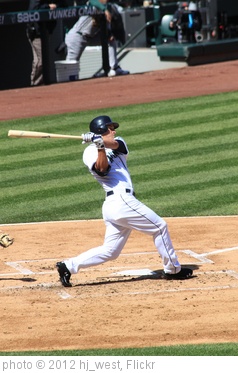
 Kyle Seager had a great season last year relative to his draft day cost (think back to your mixed league draft... was his name even called out?). Not many are taking note this year given the fact that he plays for the Mariners and that nothing he does really jumps off the page, but that doesn't mean he is someone that you should be ignoring late in mixed leagues.
First, a huge negative with Seager. Last season, in many leagues, he qualified as a second baseman (in addition to third base). Given that second sackers with strong numbers are a bit harder to find than those type of producers at third base, we secretly wish every infielder in baseball qualified at second base. Obviously, they don't. In the case of Seager, which I pointed out in Position Eligibility Matters, Seager will only be third base eligible in most leagues in 2013 after he appeared in 138 games at third base but only 18 at second base last season (14 of those games at second were starts). That's certainly a ding to the fantasy outlook of Seager. However, does that 'ding' mean people will ignore him to the point that he represents another solid draft day buy?
Quick, how many third base eligible players had 20 homers and 10 steals last year? The answer is five: Hanley Ramirez, Chase Headley, David Wright, Edwin Encarnacion and Seager. That mix of pop an a little speed is a solid draw when it comes to Seager. On the flip it's fair to question how much more he has to give in either category. A look at his minor league record shows a moderate performer in both homers and steals. In 2010 Seager had 14 homers before he went deep 10 times in 2011. That's not exactly the track record of a guy who appears likely to increase his 20 homer total from last season. It's not like he was out of control last year though – his HR/F ratio was only 9.8 percent, a totally repeatable number, and his 42.3 percent fly ball rate was also only slightly elevated (the league average is about 35 percent). If given a chance at another 600 at-bats he could repeat the homer total of last season.
As for the steals, I'm less certain there. Not an overly fast player, he's also shown the propensity to run himself into trouble. In 2010 he recorded 13 steals but was caught 12 times. In 2011 he stole14 bases but was caught seven times. Last year with the Mariners he stole 13 bags while being caught five times. Studies have shown that you have to steal bases with a success rate of at least 67 percent in order to not hurt your team. The last three years he has 40 steals while being caught 24 times. That's a 63 percent conversion rate meaning he's actually harming his team more than he is helping it. Good managers should be giving him the red light at least part of the time, though he could steal swipe lower level double digits bags again.
Seager has an 80+ percent contact rate in the big leagues, and that's a bit above average though it's not exactly something to write your Congressperson about. He doesn't strikeout much but he also doesn't walk a lot, so his 0.40 BB/K ratio through two seasons is slightly below the league average.
Seager hit poorly last season at home: .223/.307/.325 Seager hit poorly against lefties: .237/.281/.377 Seager hit poorly during the day: .228/.320/.389
I'm not saying there aren't concerns with Seager, there are as I've noted, and there is also little chance that he becomes an All-Star in 2013. He doesn't have an outstanding skill that props up his fantasy value, but if he's allowed to take the field 150+ times again the counting numbers aren't going to embarrass anyone. Remember Casey Blake? It always seemed like he was undervalued on draft day so you grabbed him in the late rounds in mixed leagues when there was no one else left, and by the time the season was over he always turned a nice profit for you. That's the kind of player Seager is. You roster him late in drafts, at a point where if he fails it won't hurt too bad, but also at a point where his 20-70-60-10 line provides you a tidy profit. That means he is nothing more than a corner infield option in mixed leagues. However, in AL-only leagues his value improves significantly to the point where you should be feeling pretty about your prospects if you can roster him at a reasonable price.
To sign up for your baseball league this year make sure you check out Fleaflicker.
By Ray Flowers