
Late Round Starting Pitching: Taijuan Walker
.jpg)

Published: Mar 16, 2016
For years, the mantra in fantasy baseball drafts has been to wait to select your starting pitchers, as pitching is deep, pitchers suffer more injuries, and pitching is too inconsistent to waste high draft picks on in non-auction leagues. I subscribed to that viewpoint, I will confess, but my experience is that those premises are no longer valid. Hitters get injured just as often as pitchers, there is plenty of inconsistency to go around in baseball that pitchers no longer have a lock on up and down seasons, and while I agree that if you are savvy enough to study starting pitchers, you can find gems in the later rounds, there is still plenty to like among the top 20-25 starters in any given season to make them a part of your draft or auction strategy. In fact, my preferred strategy is to see if perhaps a Clayton Kershaw, Madison Bumgarner, or Max Scherzer (those are my top three, but others could easily be included depending on your league setup) is available in the latter part of the first round or in the second round to provide my lock-down ace early on.
These articles that will be published prior to Opening Day, however, are not about the stud starting pitching options available in your drafts or auctions. What we are looking at are those very good options that for one reason or another are being ignored in early drafts and mock drafts. What sorts of hidden values are dropping below the 12th round in most drafts that you can snag for great value with an eye to dominating your league this season? Note: I am operating on the assumption you are drafting in a 12 team league, so all pitchers profiled here will be below the 144th pick.
I will be profiling one (or at most two) mid to late round options in the starting pitching realm on a bi-weekly basis (that is twice a week, not the alternate definition of every two weeks-why is English so difficult and confusing?). If you have questions about any pitchers and their viability as a “sleeper” pick, hit me up at ia@fantasyalarm.com and I will do my best to provide some insight. Also, I am always available to answer starting pitching (or other fantasy baseball) questions all season long.
Taijuan Walker – RHP – Seattle Mariners
2015 Stats: 11-8, 169.2 IP, 4.56 ERA, 157 K’s, 1.20 WHIP
Current ADP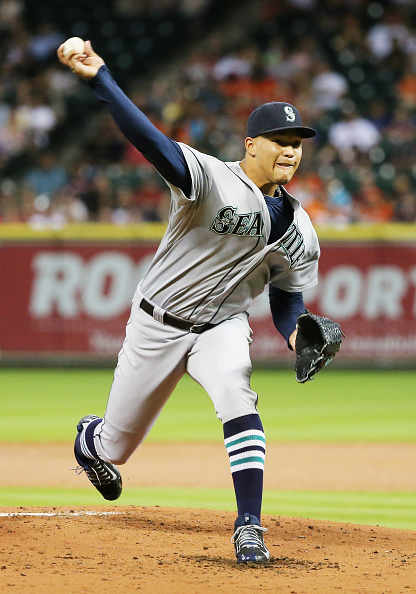
Mock Draft Army ADP: 157.9 (based on current ADPs generated by Howard Bender’s Mock Draft Army results)
National Fantasy Baseball Championship (NFBC): 166.54
FSTA Draft on January 14th, 2016: Drafted 14th round (178th overall)
LABR Mixed Draft on February 16, 2016: Drafted 11th round (163 overall)
Availability
He should be targeted in the middle rounds of your drafts, as the 23-year-old still has some development to experience to become a future ace. If he moves up in the ADP rankings to around the 12th round (as he has been doing lately, and even jumping up above that), you would be best served to avoid him this season, although he has potential in keeper and dynasty leagues.
Upside
Walker has the ability to miss a significant number of bats, as shown by his 8.33 K/9 in 2015, plus he has good control (2.12 BB/9). The control was a major improvement last year, when he began to understand how to set hitters up and not simply throw his fastball down the middle of the plate. He features a mid-90s fastball, to go with his excellent changeup, as well as the lesser-used curve and cutter in his repertoire. The 8 MPH difference between his fastball and change could be a bit more pronounced, which would help him fool more batters (a 10 MPH difference is the magic number in most cases). While he demonstrates the usual inconsistency of a young hurler, he did show signs of breaking out in the near future. Solving his long ball issue, as he did with his control, would go a long way to making him a useful middle of the rotation starter.
Downside
He showed marked improvement between his rookie season in 2014, when he had problems with his control (4.26 BB/9) and last year. His big issue that cropped up in 2015 was a drastic rise in the number of balls that left the park when he was on the mound, as he posted an ugly 1.30 HR/9 rate. A 13.0 percent HR/FB rate is not the mark of a quality pitcher, especially when you consider that his home park is more of a pitcher’s stadium and ranked in the bottom third of MLB stadiums with regard to home runs hit in 2015.
Summary
The hope is that he will overcome the recent propensity to serve up more than his proper share of gopher balls, and seeing him move his BB/9 from a horrific 4.26 in his limited action with the Mariners in 2014 to a much more attractive 2.12 BB/9 in 2015 gives hope that he is learning how to pitch, as opposed to throw. He would be a decent option later in the middle rounds of your drafts, say the 14th or 15th round in 12-team leagues, at the end of your 10-team drafts and as the third starting pitcher in 15-team or larger drafts.
Player News
{{item.text}}
{{analysis.analysis}}