
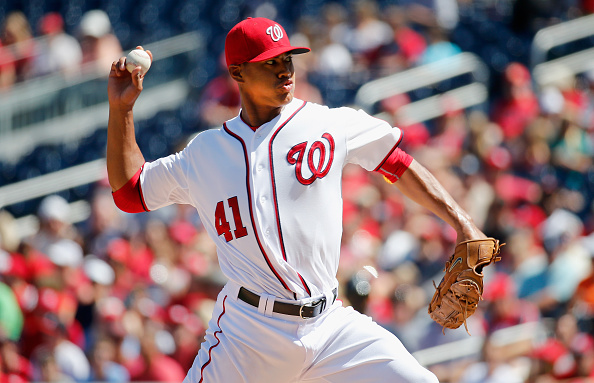

Tyson Ross of the Padres is one heck of a hurler. His younger brother, Joe Ross, is trying to get to that level of success. If his first run through the big leagues is any indication, it might not be too long before the older Ross has some competition in the household for the title of the best right handed pitcher in the family. Living off his heater/slider combo Joe – henceforth Ross – hurled an impressive 76.2 innings for the Nationals last season. What will he offer in the fantasy game in 2016, his first full season in the big leagues?
Here is a link to all the players that have been reviewed in the 2016 Player Profile Series.
THE NUMBERS
Ross was drafted in the first round by the Padres in 2011 after attending high school in Oakland.
| League | W-L | ERA | WHIP | K/9 | BB/9 | IP |
2011 | Rookie | 0-0 | 0.00 | 2.00 | 0.0 | 0.0 | 1.0 |
2012 | Low-A, A | 0-4 | 4.28 | 1.34 | 9.2 | 3.6 | 54.2 |
2013 | A | 5-8 | 4.05 | 1.34 | 5.8 | 2.9 | 122.1 |
2014 | High-A, AA | 10-6 | 3.92 | 1.26 | 7.8 | 2.1 | 121.2 |
2015 | AA, AAA | 5-3 | 2.19 | 0.89 | 5.5 | 2.6 | 76.0 |
2015 | MLB | 5-5 | 3.64 | 1.11 | 8.10 | 2.47 | 76.2 |
* Prior to last season he was ranked at the 96th best prospect in baseball according to Baseball America and 95th according to Baseball Prospectus.
THE ROTATION
As of this writing Ross, who stands 6’4” and weighs 205 lbs, appears to be slotted in to the 4th spot being Max Scherzer, Stephen Strasburg and Gio Gonzalez. Ross should sit in that 4th slot just ahead of either Tanner Roark or Bronson Arroyo. Barring a flameout, Ross seems destined to make 30 starts if he can maintain his health – though if Arroyo is healthy it is possible that Ross could be passed by said vet and Roark, though that outcome seems improbable to me.
PITCH TYPES
The guy loves his heater, and it’s a decent pitch – though not as good as one would think.
Ross threw his heater at 92.6 mph last season according to PITCHf/x.
He threw his fastball 58 percent of the time last season.
Here are the numbers for his sinking fastball.
Sinker | PAs | AVG | OBP | SLG | K-rate | BB-rate | GB-rate |
2015 | 144 | .258 | .340 | .379 | 7.6 | 10.4 | 51.3 |
While his fastball rates well, the performance on the pitch last season wasn’t standoutish in any way last season, other than his ground ball rate. In fact, that overall pitching line was decidedly average.
Ross throws that fastball which he augments with one impressive slider. Check out how batters did on the 411 of them he threw last season.
Slider | PAs | AVG | OBP | SLG | K-rate | BB-rate | GB-rate |
2015 | 131 | .135 | .168 | .246 | 42.7 | 3.1 | 54.3 |
Those numbers are insanely good, especially the strikeout and ground ball rate. Someone must have learned how to throw their slider from their older brother.
In 2015 Ross threw his fastball 58 percent of the time. He threw his slider 36 percent of the time. That left him just six percent of his total offerings being another pitch. You can have success with two pitches as a starter, but you have a much better change of sustained success if you can count on three pitches, especially if both of your main offerings are hard.
However, it’s not the sinking fastball or the slider that are the issue. It’s his secondary offerings after that duo of pitches. Ross has struggled with his changeup so he’s been working on a splitter he learned from Jonathan Papelbon. "I figured if Curt Schilling throws a splitter and he taught Papelbon to throw a splitter, I should probably try it at least one time," Ross said. “…say the changeup isn't there in a game, that will be a good alternative to try and rely on and not be so fastball, slider dominant." Ross would really benefit from developing that splitter, a pitch that can mirror a changeup in movement, and sometimes speed. Keep an eye on his development of the pitch because if it doesn’t come there is still a line of thought that believes that Ross would be a better option out of the bullpen.
2015 SKILLS REVIEW
 Ross struck out 69 batters in 76.2 innings. No real reason to think that level of production will change substantially in 2016.
Ross walked 2.47 batters per nine last season. His minor league mark was 2.6 batters per nine. No real reason to think that level of production will change substantially in 2016.
Ross throws a “heavy” baseball, i.e. one that sinks. When he keeps the ball down it’s hard to lift. Not at all surprising to see that his HR/9 mark was 0.82. No real reason to think that level of production will change substantially in 2016, especially given that his HR/FB ratio last season was a league average mark of 9.7 percent.
Ross posted a groundball rate last season of 49.8 percent. That’s an impressive mark, and one that fits his skillset.
Ross had a 34 percent fly ball rate last season, a league average mark.
Makes sense.
A bit concerned with his 16.4 percent line drive rate. As good as his stuff is, that’s a very low mark (league average of 20 percent). Odds are high that the rate will go up this season. Some expectation that the .265 BABIP will go up a bit as well.
WORKLOAD
You might have noticed above, that this isn’t exactly an arm with a lot of miles on it. Good in the sense that we would like to think that it won’t wear out in 2016. A concern in that we just don’t know how many innings he will be allowed to throw this season by Nationals’ brass. Take a look. In parenthesis is the increase in innings from the previous season.
2011: one inning
2012: 54.2 innings
2013: 122.1 innings
2014: 121.2 innings
2015: 152.2 innings
As you can plainly tell, he’s yet to throw 155 innings in a season. He’s thrown 125 innings once in his young career. I would say the upper end for Ross is 180-innings this season, that is if his arm can even handle that many innings… we just don’t know if he can yet.
Have you picked up your copy of the 2016 MLB Draft Guide yet? The Guide includes more than 600 Players Ranked, auction values, .png) rookie reports, hitting and pitching targets as well as all the info you need if you’re ready to start playing DFS.
rookie reports, hitting and pitching targets as well as all the info you need if you’re ready to start playing DFS.
OUTLOOK
Ross should start. Should. He should be allowed to make 30-starts this season. Should. We aren’t certain that either of those statements will come to fruition, but we feel good that he should be able to. He owns solid skills and doesn’t beat himself with the walk like his brother does. If he can develop that third pitch, the split-fingered fastball, then we could have one hell of a starting pitcher.
10-team Mixed: Draft him sure, but he’s a stretch as a fifth SP in this format given the enumerated concerns. A big arm though, so taking the plunge is a smart thing. If things don’t work out, you will always be able to find another arm off the wire.
12-team Mixed: A 5th starter type. Love the grounders, and the big strikeout potential. The lack of walks figures to limit the WHIP damage as well – the one thing that holds back his brother in the fantasy game.
15-team Mixed: Well worth a plunge. If he’s your 4th starter you better have a stable 5th option you can turn to just in case things go horribly wrong. All the time I say – you want strikeouts, grounders and no walks. On the surface, Ross fills those expectations. Now it’s about developing that off-speed pitch and showing that his arm can handle the innings.
NL-Only: You can go boring innings eaters for part of your staff, but you also need those upside plays. Ross profiles as a pitcher that shouldn’t hurt your ratios, and one that will strikeout out a good deal of batters. He’s young, and would appear to have a role in the rotation on lockdown. No reason not to invest heavily in Ross in this format, even with the listed concerns.
To see where Ross ranks take a look at our 2016 Rankings that are part of the MLB Draft Guide.
Ray Flowers can be heard Monday through Friday, 7 PM EDT and Friday on SiriusXM Fantasy Sports Radio (Sirius 210, XM 87). You can also hear Ray Sunday nights at 6 PM on the channel talking fantasy sports. Follow Ray’s work at Fantasy Alarm and on Twitter (@baseballguys).
Player News
{{item.text}}
{{analysis.analysis}}