
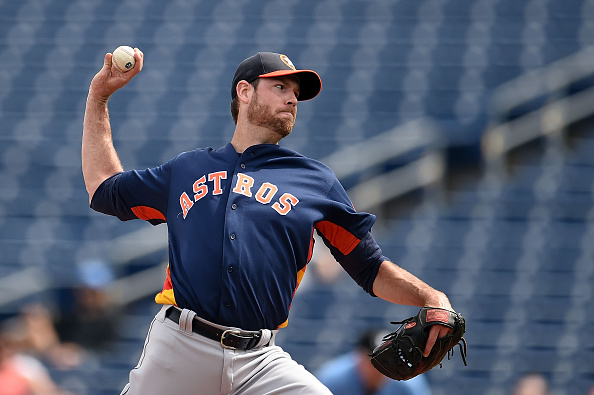

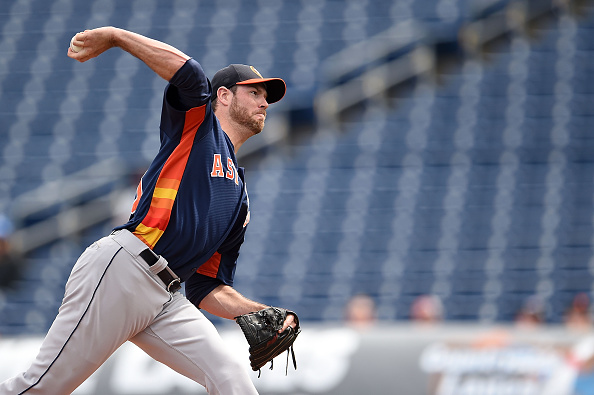
 Doug Fister was a solid hurler for years, that is until last season when he crashed and burned. Now an Astro, will the 32 year old be able to rebound in 2016?
Doug Fister is 32 years old, right-handed, and stands about 6-foot-8 (he weighs in at a massive 210 lbs). He doesn’t beat himself with the walk, usually is a solid ERA and even WHIP option, and in 2013-14 the guy also captured 30 wins, tied for sixth best in baseball. Last season, though, things cratered as he threw his fewest innings since 2009 due to elbow issues (he missed more than a month of action) and a late season move to the bullpen. What do we make of a guy who was at one time a nice reserve round bid in mixed leagues coming off that disappointing season?
Here is a link to all the players that have been reviewed in the 2016 Player Profile Series.
THE NUMBERS
| W-L | ERA | WHIP | K/9 | BB/9 | IP |
2009 | 3-4 | 4.13 | 1.28 | 5.31 | 2.21 | 61 |
2010 | 6-14 | 4.11 | 1.28 | 4.89 | 1.68 | 171 |
2011 | 11-13 | 2.83 | 1.06 | 6.07 | 1.54 | 216.1 |
2012 | 10-10 | 3.45 | 1.19 | 7.63 | 2.06 | 161.2 |
2013 | 14-9 | 3.67 | 1.31 | 6.86 | 1.90 | 208.2 |
2014 | 16-6 | 2.41 | 1.08 | 5.38 | 1.32 | 164 |
2015 | 5-7 | 4.19 | 1.40 | 5.50 | 2.10 | 103 |
Career | 13-12 | 3.42 | 1.21 | 6.1 | 1.8 | 213 |
* Average per 162 games
HEALTH / WORKLOAD
Fister battled elbow woes last season, a flexor tendon issue, and it caused his workload to plummet (a move to the bullpen didn’t help either). As a result of the injury his mechanics changed a bit as well, hampering his success.
"My mechanics were a little off, and I didn't realize it until a little too late," Fister said. "I finished strong. I felt like my velocity got back. I felt like my delivery was back. I was getting life on the ball, getting that ground-ball contact. I think that was a huge factor for me in the confidence. I can still pitch. I can do my job whether it's a bullpen guy or starter."
Fister was asked to work out of the bullpen last season, the first time he had done that in his big league career (he made 10 of his 13 career bullpen appearances last season).
The Astros figure to slot Fister in as their fourth rotation option this season behind Dallas Keuchel, Colin McHugh and Lance McCullers. Of course, that all depends on his health and spring training work as the club has two others they could turn to in the 4/5 slots in the rotation in Mike Fiers and Scott Feldman. It sounds like Fister is being counted on to take the ball 30 times this season.
Looking at his track record we see a moderate arm in terms of workload. He’s hit 200 innings twice but in none of the other seven seasons in his career does he have a season of 175 innings. In fact, out of seven seasons Fister has thrown 165 innings just three times. He’s likely to miss time in 2016, it’s just what his track record suggests.
STRIKEOUTS
Glance back to the top and you will notice a distressing trend. After posting a career best mark of 7.63 per nine in the strikeout category in 2012, Fister has failed to reach 6.9 strikeouts per nine in any of the last three seasons. That’s not a shock given that he owns a 6.07 career mark, but the fact that he’s failed to reach even that low “career” bar the last two seasons is a concern (the last two years the mark has been 5.38 and 5.50). Think of it another way. The last two seasons his 5.43 mark is more than two full batters below the league average of 7.79 per nine. Yet another way to look at it. The last two seasons Fister has 161 strikeouts over 267 innings. Dellin Betances has 266 strikeouts, 105 more, in 174 innings (that’s 93 fewer). Fister is deficient in strikeouts, and even if he gains back a few mph on his fastball that doesn’t figure to do anything other than boost his K-rate back up to his career average.
WALKS
Fister has success because he doesn’t beat himself. For his career he owns a sterling 1.77 walk rate per nine. Amongst pitchers who have thrown at least 1,000 innings since the start of the 2009 season, that 1.77 mark is third best in baseball (Cliff 1.32 and Dan Haren 1.70). Fister was over that mark last season with a six year worst of 2.10, still an excellent mark. The regression isn’t a good thing, and it bears watching, but Fister did produce a career best 1.32 mark in 2014 giving him a 2-year average of 1.62. He doesn’t beat himself.
RATIOS
Fister posted a career best 2.41 ERA in 2014.
Fister has a 3.42 career ERA.
Last season the mark was a career worst 4.19. As we are learning, unfortunately, it was earned. In fact, if we look at his SIERA and xFIP marks, 2015 wasn’t any better than it looked on the surface.
| ERA | SIERA | xFIP |
2014 | 2.41 | 3.93 | 3.85 |
2015 | 4.19 | 4.47 | 4.46 |
Career | 3.42 | 3.85 | 3.78 |
We kind of keep coming back to it, don’t we? He was too good in 2014. He was too bad in 2015. But, if you add his two seasons together you end up with numbers that are closer to his career levels than you might think. Check it out: 3.10 ERA, SIERA 4.15 and xFIP 4.08. Does that mean he will be right back in the middle in 2016?
Fister owns a 1.21 WHIP for his career. In three of the last five seasons he’s bettered his career rate which on the surface sounds great. However, in two of the last three seasons the mark has been worse than the league average with a 1.31 rate in 2013 and 1.40 in 2015. That’s not good. Given his lack of punchouts you simply cannot roster Fister with any confidence in 2016 unless you can trust that the WHIP will be his career mark, not the league average. Keep that in mind as we move forward.
BATTED BALLS
When you throw your fastball 86 mph your margin for error is razor thin. That line last season, well, Fister fell on the wrong side of the law. After posting a HR/9 mark under 1.00 in each of the previous five seasons, the mark climbed to a career worst 1.22 in ’15. That was partly because his HR/FB ratio was a six-year high at 12.0, and partly because he posted a 34.1 percent fly ball rate (though the rate was league average, it was three percentage points above his career mark of 31.2 percent). Further, as the homers left the yard at a higher frequency, the grounders took a dip as well. After posting a career best ground ball rate of 54.3 percent in 2013 the mark dipped to 48.9 percent in 2014 and then down to 44.6 percent last season. Fister owns a 48.8 percent career mark so his 2014 effort was right on par, but last season – ugh. The result of everything the last two seasons has been GB/FB ratios of 1.43 and 1.31, below the 1.56 career mark he owns. Things are not trending in the right direction for a guy that must keep the ball on the ground to have success.
One final note. As a ground ball arm, Fister benefits from having a solid defense behind him. The Astros had the best OOZ in baseball last year (Out Of Zone – plays made by fielders on balls hit outside their zone). At least that’s something positive for Fister.
Don’t forget to pick up your copy of the 2016 MLB Draft Guide which includes more than 600 Players Ranked, auction values, rookie reports, hitting and pitching targets as well as all the info you need if you’re ready to start playing DFS.
OUTLOOK
Fister is said to be throwing harder this spring. That’s key. If he’s throwing 89 his stuff plays. If he’s throwing 86 it’s touch and go. Regardless, his overall game isn’t one that impresses which marks him as a fringe arm in most setups.
10-team Mixed: The righty from the Astros simply shouldn’t be drafted in this format. No strikeouts, some health concerns, and unstable ratios paint him as a no go.
12-team Mixed: Nothing other than a spot starter. There’s no reason to draft him. He should start out in the Astros rotation, but there are warts everywhere. If he starts off the season looking sharp you could consider adding him when injuries strike your team, but he’s nothing more than that.
15-team Mixed: Fister is still not draftable in this format, I would prefer to have you roster strong bullpen arms instead, but he can be on your watch list of potential adds once we get into the season.
AL-Only: Someone will draft him here, and it could be you. The reason is that you will not have to reach unless your home league is in Houston. There is no heat behind Fister, no excitement whatsoever, so rostering him to round out your rotation isn’t a bad idea. If he hits, great. If he fails, you won’t have lost much. He should be a league average type in the ratio categories with the potential to be a bit better, and that is a bit interesting.
To see where Fister ranks take a look at our 2016 Rankings that are part of the MLB Draft Guide.
Ray Flowers can be heard Monday through Friday, 7 PM EDT and Friday on SiriusXM Fantasy Sports Radio (Sirius 210, XM 87). You can also hear Ray Sunday nights at 6 PM on the channel talking fantasy sports. Follow Ray’s work at Fantasy Alarm and on Twitter (@baseballguys).
Player News
{{item.text}}
{{analysis.analysis}}