
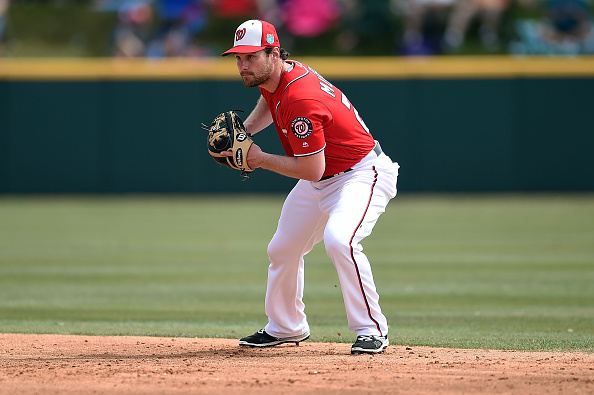

Last we saw Daniel Murphy he was with the Mets and blasting the ball as if he was the reincarnated Darryl Strawberry (Murphy had a 1.115 OPS with seven homers in 14 playoff games). Murphy isn’t that talented a hitter though it was a hell of a run, and he’s no longer a Metropolitan after signing a 3-year, $37.5 million deal with the Nationals. The current plan has Murphy as the starting second sacker for the Nats – he appeared in 17 games at first base, 69 at second and 42 at third base last season – and he should be as productive as always given the game that the 30 year old brings to the dish (he will be 31 on April 1st, my b-day as well so he must be a good guy). Let’s explore Murphy’s skill set to make sure we understand just who Murphy is.
Here is a link to all the players that have been reviewed in the 2016 Player Profile Series.
THE NUMBERS
| GAMES | AVG | HR | RBI | Runs | SB |
2009 | 49 | .313 | 2 | 17 | 24 | 0 |
2010 | 155 | .266 | 12 | 63 | 60 | 4 |
2011 | 109 | .320 | 6 | 49 | 49 | 5 |
2012 | 156 | .291 | 6 | 65 | 62 | 10 |
2013 | 161 | .286 | 13 | 78 | 92 | 21 |
2014 | 143 | .289 | 9 | 57 | 79 | 13 |
2015 | 130 | .281 | 14 | 73 | 56 | 2 |
Average | 162 | .288 | 11 | 72 | 76 | 10 |
APPROACH
Murphy is what they call, in baseball jargon, a “professional hitter.” Murphy owns a .288 career mark in the batting average category and in each of the past five seasons his batting average has been at least .281. Stability he brings in this column.
Murphy owns a 23.1 percent line drive rate. He’s been under that impressive mark in 2/3 seasons, though each of the last five seasons the mark has been at least 21.1 percent. He is consistently above the league average in this measure.
Murphy owns a .314 career BABIP. In four of the last five seasons the mark has been at least that high. The only time the mark has dipped was last season when it fell to .278. History strong suggests that the mark will improve substantially in 2016.
A note on this. Last season Murphy pushed his pull rate to 41 percent. The mark is just 34 percent for his career. He clearly made a decision to try and pull the ball a bit. We’ll get back to that in the power department but let’s just say that a return to his “old” approach, one where he was more willing to spray the ball all over the field, would aid him in his ability to improve his batting average.
Murphy is able to get on base at a decent clip, his career OBP is .331, but his OBP is really about his batting average since he’s not exactly a big walk maven. For his career Murphy owns a 6.0 percent walk rate and he has never walked even 40 times in a season. He’s just not a big walk type of guy. At least he doesn’t strike out. In fact, he’s never struck out 100 times in a season, and last year he cut his strikeout rate down to 7.1 percent, the best mark of his career and a near 50 percent reduction on his 13.4 to 13.6 rate from 2012-14. He puts the ball in play.
POWER
The league average for Isolated Power (SLG-AVG) is usually around .140. For his career Murphy has a .135 mark. Last year the rate was a career best .168, but it was the first time in four seasons that he crested his career Isolated Power mark.
Last season Murphy posted a slugging percentage of .449. That was his best mark since his rookie season of 49 games played. It was also the first time in four seasons in which his SLG bettered his .424 career mark.
Murphy owns a .755 career OPS. Only once in the last four seasons has Murphy bettered that mark (last season he was at .770).
Murphy, simply put, isn’t a power bat.
I noted that he started to pull the ball more than ever last season, and he had that great power run in the playoffs too. Daniel even hit 14 homers during the regular season, the best mark of his career. However, at the age of 31 hitting 14 homers really isn’t anything substantial now is it?
Murphy has a 33 percent fly ball rate for his career and in two of the last three seasons his fly ball rate has been 36.3 and 36.0 percent. That’s a bit more fly ball love but still barely better than the league average of 34 percent. It’s just not his game though, hitting the ball in the air. Even last season with the second best fly ball rate of his career he couldn’t hit 15 home runs. The reason is that when he hits the ball in the air it doesn’t go far enough. Murphy posted an 8.3 home run to fly ball rate last season. That mark is below the league average of 10 percent even though it is a career best. That’s right, Murphy owns a 6.4 percent HR/FB ratio for his career. If he hits the ball in the air he makes outs, simple as that.
SPEED
In three of the last four seasons Murphy has stolen at least 10 bases. In those three seasons he averaged 15 thefts a year. Unfortunately, that party came crashing to an end last season as he stole just two bases in four attempts. At his age it’s not a given he will return to running with health, but Dusty Baker likes to make things happen and it’s not at all unreasonable to think Murphy could sniff double-digit thefts again.
RBI / RUNS
His spot in the batting order is key to his value.
Murphy has never driven in 80 runners in a season. Twice in the last three campaigns he has crested 70 runs batted in so there is that, but he’s just not likely to be a big run producer. He doesn’t drive the ball well enough to be a legitimate run producer though it should be noted that he’s always come through when the pressure was on. Over the course of 895 plate appearances with runners in scoring position Murphy has hit .313 with a .374 OBP and .462 SLG leading to an .870 OPS. Those numbers are eons better than the same marks when the bases are empty (.282/.318/.412). He’s always performed better when the lights were brightest.
As we noted above, he really doesn’t get on base very well and the power isn’t likely to grow, so the only way that he’s going to push things in the runs scored column is if he hits near the top of the order. Only once in his career has Murphy scored 80 runs, and only twice has he crossed home plate more than 65 times in a season. He’s just not a strong option in this category.
POSITIONAL FLEXIBILITY
To reiterate what was said in the open.
Position | Games Played |
1B | 17 |
2B | 69 |
3B | 42 |
Don’t forget to pick up your copy of the 2016 MLB Draft Guide which includes more than 600 Players Ranked, auction values, .png) rookie reports, hitting and pitching targets as well as all the info you need if you’re ready to start playing DFS.
rookie reports, hitting and pitching targets as well as all the info you need if you’re ready to start playing DFS.
OUTLOOK
A solid batting average, coupled with multi-position eligibility, mark Murphy as an option in virtually every setup. As a second sacker his bat plays, and the other stuff is a nice bonus.
10-team Mixed: Is he a top-10 second baseman? Maybe. Is he good enough to be a middle infield option? Sure he is. Even in a league this thin a guy who could hit .290 with 10 homers and 10 steals is a worthwhile addition.
12-team Mixed: A starter at second base can Murphy be. More of a treading water type option, but if you miss out on the elite plays at the position why not just settle in late with a guy you can trust to be stable, even if stable is a bit boring.
15-team Mixed: That positional flexibility is nice since I don’t want to have to run to the wavier-wire to add Zack Cozart to fill a middle infield spot if I need a boost in May. On the cheap will Murphy be as so many others with names like Odor and Wong generating all the hype. If waiting to roster your second sacker ideal is he.
NL-Only: Stability in batting average? Check. A spot in the daily lineup? Check. Multi-position flexibility? Check. If you check off those three simple categories there’s a place for you on my squad. He’s not sexy either so odds are that he will be a moderately priced player on draft day, just the type of player I like to build my team around.
To see where Murphy ranks take a look at our 2016 Rankings that are part of the MLB Draft Guide.
Ray Flowers can be heard Monday through Friday, 7 PM EDT and Friday on SiriusXM Fantasy Sports Radio (Sirius 210, XM 87). You can also hear Ray Sunday nights at 6 PM on the channel talking fantasy sports. Follow Ray’s work at Fantasy Alarm and on Twitter (@baseballguys).
Player News
{{item.text}}
{{analysis.analysis}}