
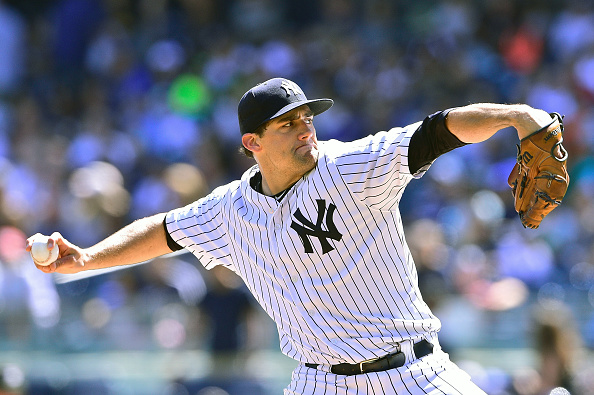

With the baseball season fast approaching and Spring Training upon us, Fantasy owners are beginning to compile their rankings and projections for 2016. Sorting through established players and household names is one thing, but leagues are never won by big-named stars performing at their expected statistics. Instead, crowns are donned by the owners who were able to sift through the first 200 players selected and draft upside “deep sleepers” (ones who are able to greatly outperform their ADP and provide exceptional value to their owners). Which players qualify for that distinction this season? Read on and find out.
Player: Nathan Eovaldi
Team: New York Yankees
Age: 26
Position: SP
2015 Statistics: 14-3 record over 154.1 IP / 4.20 ERA / 1.45 WHIP / 121 Ks
Current ADP: 281 (Fantasy Pros)
Background
One piece of statistical data that I enjoy using for gauging who would constitute a deep sleeper is their performance in the second half of the prior season. Sure, it isn’t the be-all, end-all benchmark to determine future success, but it provides an interesting barometer to measure against. Case in point? Nathan Eovaldi.
In a nutshell, his 2015 freshman campaign with the Yankees was truly Jekyll and Hyde, centered around the All-Star break. Prior to the break, Eovaldi struggled heavily against left-handed batters (their first half OPS was a ridiculous 1.008), which directly led to his inflated 4.50 ERA and 1.52 WHIP. After a bit of soul-searching and sessions with the team’s pitching coach, Eovaldi developed a splitter that effectively kept lefties in check for the remainder of the season, and led to dramatically improved splits (he owned a 3.67 ERA and 1.33 WHIP after the break) – a true godsend to his statistics for fantasy owners. Should Eovaldi be able to carry over his success from the second half, expect him to enter the SP3 discussion in mixed leagues.
Positives
1.) Ability to minimize damage – As mentioned earlier, Eovaldi made great strides since joining the Yankees last season, particularly in his ability to decrease the number of baserunners, and having an uncanny knack for keeping the ball in the yard. While pitching for the Miami Marlins in 2013-14, Eovaldi posted ground ball rates of 43.8 percent and 44.8 percent, mediocre at best. Since developing his splitter, that number steadily rose up to 52 percent, causing his ERA and WHIP to subsequently dip. Additionally, his HR/FB% remained south of 7.8 percent, as he only allowed 10 home runs the entirely of 2015. Every metric suggests that his updated arsenal has resulted in him inducing much weaker contact.
2.) Elite levels of run support – Owners may opt to forget it, but the Yankees actually finished second in baseball last season in runs scored, and fourth in home runs and slugging percentage. Are they an aging team still full of overpaid veterans? Yes. Will Alex Rodriguez and Mark Teixeira combine to smack another 64 home runs? Likely not. Yet for all of their shortcomings, this team can still put up plenty of runs, and some would argue they have improved this season after adding Starlin Castro. Eovaldi will continue to receive plenty of runs from this offense, which will allow him to improve upon last season’s career-high 14 wins.
Negatives
1.) Inability to stay healthy – Various ailments have prevented Eovaldi from ever throwing more than 200 innings in a season (yes, I’m aware he threw 199.2 in 2014, but that is still under 200!). In fact, when you exclude his 2014 season with the Marlins when he finally managed to stay healthy, over his other three years in the major leagues his averages are downright frightening – 126.4 IP, 22 games started per year. Last season ended prematurely (again) due to elbow concerns, and in late February he was already complaining of groin tightness. His fragility limits his upside.
2.) Lack of above-average tertiary pitches – While I touched on the positive effect that Eovaldi’s budding splitter has had on his statistics, he still overwhelmingly relies upon his four-seam fastball. Both his slider and curveball grade out as below-average options at best, and due to the lack of a successful third option to fallback upon, hitters will make the adjustment and begin to hone in on his repertoire. Predictability is the death of success for a starter in the majors, and although Eovaldi made some major improvements last season, he still has a large gap to cross before fantasy owners can rely upon him each outing.
3.) Lack of long outings – Looking for a starter that can work deep into games? Keep searching. Eovaldi has yet to record a complete game in his entire career, and given how manager Joe Girardi likes to limit his starter’s innings and rely upon his incredible bullpen, don’t expect this trend to change.
Player News
{{item.text}}
{{analysis.analysis}}