


If you have learned anything so far it is that the situation in fantasy football is even more important than the individual players themselves. By now you should have identified several situations across the NFL in which you would like to buy stock this season. Once you realize it is the system that makes the player and not the other way around, you understand the power of the handcuff.
Let’s take a quick tour through history to prove the power of the handcuff. Remember the Denver Broncos under Mike Shanahan back in the mid-90’s and early 2000’s? When Terrell Davis went down with an injury in 1999, Orlandis Gary took over and rushed for 1,159 yards in 12 games. In 2000, when both Davis and Gary got hurt, Mike Anderson took over and rushed for 1,487 yards again in just 12 starts. There are plenty more recent examples. In 2011, Bills running back Fred Jackson was tearing it up until Week 11 when he broke his leg. Enter disappointing second year player C.J. Spiller who went on to average 112 yards per game while racking up five touchdowns in five games. In 2012, Eagles All-Pro running back LeSean McCoy went down with an injury before Week 11. Seventh round rookie Bryce Brown drew the start and rushed for 178 yards and two touchdowns against the Panthers. The following week he went off again against the Cowboys for 169 yards and two more touchdowns. In 2013, we all remember what happened when Jay Cutler went down twice with an injury and his journeyman backup, Josh McCown, came in to throw for 1,329 yards, 11 touchdowns and just one interception in five starts. McCown was a QB1 in fantasy leagues running Marc Trestman’s offense in Chicago.
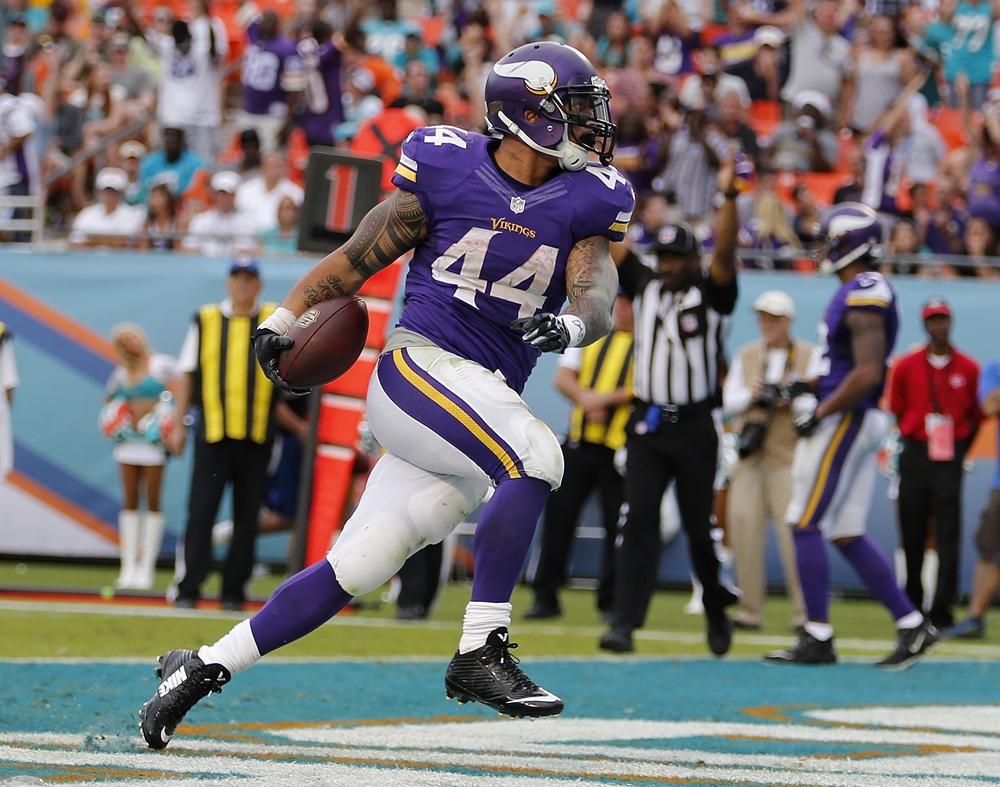
Then there was last year when the Adrian Peterson news broke after Week 1. This was obviously devastating news if you were a Peterson owner. Not only were you without your first round pick and top running back, but you were up a creek without a paddle if you didn’t handcuff him with Matt Asiata. Asiata went on to score 19.4 points in a PPR format in Week Two. Astonishingly, Asiata was a top 14 RB in PPR formats last season. You may be saying that these are just extreme examples, but the problem is that it happens every year.
The lesson here is Orlandis Gary, Mike Anderson, C.J. Spiller, Bryce Brown, Josh McCown and Matt Asiata were all far from fantasy relevant on draft day. But when forced into action, they each became highly productive fantasy players overnight. In each case it is because the system was focused on utilizing either the quarterback or running back no matter which jersey number was lining up at the position.
Handcuffing obviously works for quarterbacks and wide receivers too. Remember when Matt Cassel ran Josh McDaniels’ offense in New England? He was 10-5 and threw for 3,693 yards and 21 touchdowns in 2008. Yes this is the same Matt Cassel who then proceeded to win just four games the following year in Kansas City and couldn’t even hold the QB1 job in Minnesota last year. How about when Marvin Harrison went down in week five of the 2007 season for the Indianapolis Colts? Reggie Wayne stepped in and delivered 1,510 yards and ten touchdowns. Too long ago you say? How about in 2012 when Greg Jennings missed most of the season with a groin injury? Randall Cobb stepped up and became the top dog in Green Bay leading to Jennings taking some sour grapes with him to Minnesota the following year.
I hope that you all see the symmetry here between the systems and the success of everybody who gets an opportunity to touch the ball in that system. When you make a commitment to a player who is in a great system it makes a lot of sense to insure yourself by handcuffing that player. This locks you in to a positive fantasy situation and practically eliminates the constant concerns about injury that all fantasy owners have year in and year out.
Player News
{{item.text}}
{{analysis.analysis}}