
SiriusXM Host League: Practicing What I Preach

Published: Mar 23, 2016
 Every so often I’ll receive an email from a reader asking if the opinions I offer or the strategies I recommend are actually used by me in my own leagues. Seems like a fair enough question. Do I really put my money where my mouth is? The answer is yes. Of course I do. I’m not going to sit here and hype a player for the sake of hyping him and I’m certainly not going to tell you to employ a strategy I’ve been working on in the Mock Draft Army and then not use it myself. How would I be able to test it out? Or more importantly, how would you ever be able to trust me?
So here we go…
Two weeks ago, I wrote a piece citing my early-round attack strategy. I used it in a number of mock drafts and each time I used it, no matter from which position I drafted, the teams I built were both balanced and strong. If you don’t remember the strategy, then feel free to click the above link and check out that piece again. For here, though, allow me to show you how I implemented the strategy for one of my leagues and show you how it, as I knew it would, work like a charm.
Welcome to the SiriusXM Host League!
15 teams, standard 5x5 mixed-league roto, standard positions with a corner and a middle infielder, one utility, five outfielders and nine pitchers.
I had the 11th pick out of 15, a spot I wasn’t exactly in love with, but considering I worked this strategy from a variety of angles, I was confident in my ability to walk away with a top team.
Remember, the strategy dictates that, by the end of the seventh round, I have two starting pitchers, two outfielders, a first baseman, a third baseman and then a seventh player from anywhere. If the flow of the draft dictates that I take another starter, then so be it. If outfielders are flying off the board at a much more rapid rate than usual, then maybe I look into taking a third guy if the talent level is above where I have set my floor. I would even consider grabbing another first baseman if the value was right. That’s why you have a corner infield and/or utility spot.
There is also no order in which you need to select these players. If you’re the type of fantasy player who needs to have Carlos Correa as your shortstop, then so be it. Draft him in the first round and cover the other positions during your next six picks. Just remember that your “wild card” has been used in the first round, so if you’re a big Robinson Cano fan, you’re changing up the strategy should you draft the Mariners second-sacker in addition to Correa.
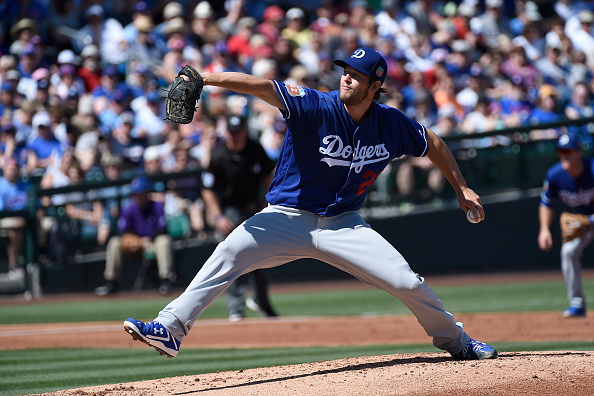
 I was absolutely stunned to see Clayton Kershaw fall to me at the 11th pick. Stunned. For the most part, the industry has really embraced the selection of top starting pitchers in the early rounds and I’ve never seen Kershaw fall out of the top seven or eight in any mock draft done this year. But apparently the Fantasy OG possessed those in the draft room and the No. 1 pitcher in baseball fell into my lap. I certainly won’t complain.
When my second pick rolled around, I was ecstatic to see Jose Abreu still out there. He was the highest-rated hitter available on my board and who doesn’t love the security of a 30-100 first baseman? I also didn’t have to worry about a lengthy injury history like that of Edwin Encarnacion or a crappy batting average like that of Chris Davis. As for the other positions available within my strategy, none of the players available touched the ability of Abreu.
As expected, the bulk of the next 20 picks were starters and outfielders. In fact, seven of each came off in that run and still Justin Upton was there for me in the third. Imagine this kind of a talent batting second in the Tigers lineup, right in front of Miggy? Talk about your low-hanging fruit. I actually considered Todd Frazier here with the three teams behind me having loaded up on outfielders early, but I didn’t want to chance it. Upton is high on my board and should have an outstanding year. My instincts were right as three more outfielders peeled off the board after I took him.
My fourth pick was actually where the most thought went in. I liked a few of the starters available such as Dallas Keuchel, Carlos Carrasco and Noah Syndergaard, third base was getting dangerously close to my floor and I even thought about Cano as my “wild card.” But in the end I went with Yasiel Puig as the drop-off in talent from Puig to the rest of the available outfielders was fairly significant. Now , obviously there are concerns about Puig, who failed miserably in living up to his hype last year. There are attitude problems, injury risks and a a history of missing games due to disciplinary reasons. However, the upside of a breakout year is a very high ceiling and I like the way new manager Dave Roberts is trying to connect with the enigmatic outfielder on a personal level. If he can bring out in Puig everything that Donnie Baseball failed to do, then we could be looking at a legitimate 20-20 candidate.
A mad rush of starting pitchers coming off the board in rounds four and five pushed me close to my floor for the position so I knew I was going to have to make that grab with my fifth pick. I was eyeballing Johnny Cueto and Danny Salazar but had a strong hunch that Salazar wouldn’t make it to me with Joe Pisapia picking in front of me. My hunch was, of course, right and after Dr. Roto took Kyle Seager, Cueto was mine. There are some skeptics out there, but the move back to the NL and into a pitcher’s park like AT&T Park tells me that strikeouts are on the rise and the ratios are coming down.
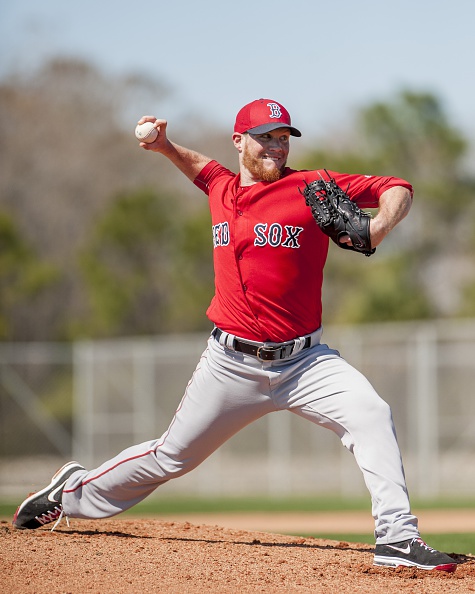 With Seager coming off the board, I was getting a little nervous about my third baseman. There were six teams that still needed to fill the position and there were only four players out there before I passed my floor. But when I saw Craig Kimbrel just hanging out there, I deemed it worth the risk of having to downgrade at third. Not many were high on Evan Longoria, my floor at the hot corner, so I grabbed the No. 1 closer in the game as my wild card pick and kept my fingers crossed.
Considering the way this draft fell to me, you had to know there was a happing ending with this strategy and yes, that occurred when Longoria fell to me with my seventh pick. Had he not, I probably would have reached a round and gone with Mike Moustakas who some folks still seem to like and even rate higher than Longo. I don’t, but some do. I wouldn’t have been thrilled, but I would have managed.
After that, as you can see, it was pretty easy to round out the rest of my team. I grabbed some power and some speed in the outfield, managed to add Brian McCann as my top backstop, filled in my middle infield with some nice veterans like Starlin Castro and Neil Walker and added some solid middle-of-the-rotation fantasy starters in John Lackey and Wei-Yin Chen. One of the biggest keys in rounding out my roster was to stick with the veterans people were dismissing for some hopeful youngsters. Alexei Ramirez, Alcides Escobar and even super-sub Brock Holt all landed on my roster in lieu of fighting the early-season FAAB bidding to fill holes created by late-spring rookie demotions.
To criticize my draft, I will say that I came up short on the second closer. I usually like to take one elite and one upstart, but in Round 16 I ended up drafting Dellin Betances after Will Smith was snagged by Adam Ronis a few picks earlier. I could have gone with someone like Santiago Casilla or J.J. Hoover, but I decided that Betances, with his strikeouts and share of saves and wins, was a more valuable commodity to the team overall. So for the first time in a VERY long time, I’ll be one of those guys chasing saves on the wire this season.
Overall, though, I love my team. Love my strategy. Love them. Not only do I have a strong balance of power and speed, but my pitching is going to be extremely competitive in all categories but saves. The foundation built in the first seven rounds is incredibly strong and should be the core of my team throughout the year. Chalk up another successful endeavor for my early-round attack strategy and watch as I use this draft as a springboard to a championship.
Player News
{{item.text}}
{{analysis.analysis}}